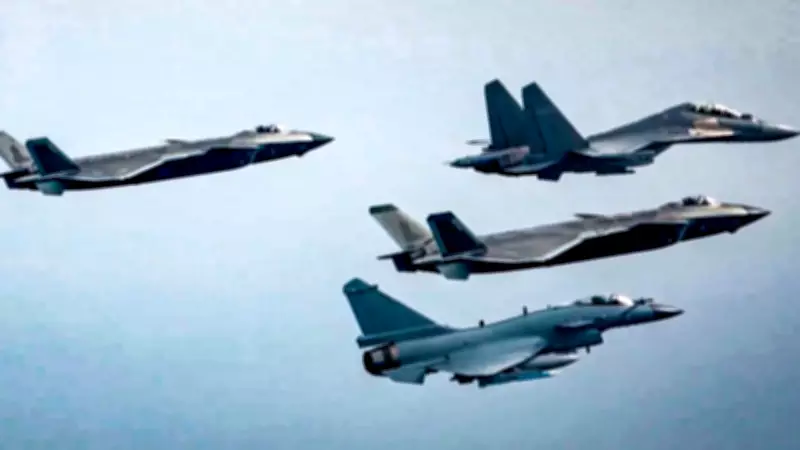
China Enforces Extensive 40-Day Airspace Restriction Near Shanghai
China has implemented a sweeping ban on civil aviation across a massive airspace zone off the coast of Shanghai, effective for a period of 40 days. The restriction, announced without any official reason, was detailed in a Notice to Airmen (NOTAM) published by the United States Federal Aviation Administration (FAA). This significant aviation directive will remain in force until May 6, 2024.
Scope and Details of the Airspace Closure
The FAA notice was posted online on March 27 at 1150 GMT and became operational just a few hours later. The prohibited airspace encompasses a staggering area of 73,000 square kilometers, which is approximately twice the size of Taiwan. This restricted zone is situated a few hundred kilometers to the north of the island of Taiwan.
The ban specifically applies to five distinct zones: two are located over the Yellow Sea, positioned between China and South Korea, while the other three stretch across the Yellow Sea and the East China Sea, lying between China and Japan. Notably, these closed areas are separated by an air corridor that is about 100 kilometers wide. This corridor allows for continued access to Shanghai from the Yellow Sea for authorized flights.

Expert Analysis and Unusual Nature of the Restriction
NOTAMs are standard alerts issued to inform aviators of unusual conditions that could affect airspace safety. They are typically published in advance of planned military exercises or during exceptional events such as large-scale fires or volcanic eruptions. However, aviation and security experts have highlighted that the scale, duration, and nature of this particular restriction are highly unusual.
Maritime security expert Benjamin Blandin, a researcher at Taiwan's Institute for National Defense and Security Research (INDSR), stated to AFP that "there is no possible use other than military" for this type of extensive airspace closure. He elaborated, "It could be to fire missiles, carry out air exercises, etc. We don’t know."
Aviation and defence consultant Xavier Tytelman emphasized that the restriction is "out of the ordinary" due to its enormous size, the lengthy 40-day duration, and the complete lack of any altitude limitations, either high or low. Tytelman explained that in this context, it effectively means "the government is reserving a zone for itself." The ban applies strictly to civil aviation and does not necessarily restrict military aircraft, helicopters, or drones.
Historical Context and Strategic Implications
Benjamin Blandin pointed out that this is "the very first time" China has imposed an airspace restriction in a manner that is "so sudden, geographically extensive, prolonged over time, and so poorly documented." He noted that normally, such announcements are made weeks or months in advance, accompanied by explanations and justifications, and often include altitude limits to permit the passage of commercial aircraft.
According to a senior security official from Taiwan, China may be leveraging the current distraction of the United States due to the ongoing Middle East conflict to expand its active military presence and conduct harassment operations in the Indo-Pacific region. The official suggested that China's objective is to deter U.S. allies in the area and weaken American military influence across the Indo-Pacific.
For Blandin, this NOTAM is part of a "continuing series of access denials" and "bolsters China's strategy of nibbling away at the land and sea borders of its neighbours" that has been observed over the past 15 years. This action is viewed as a component of broader geopolitical maneuvers aimed at asserting dominance and testing regional boundaries without overt military confrontation.