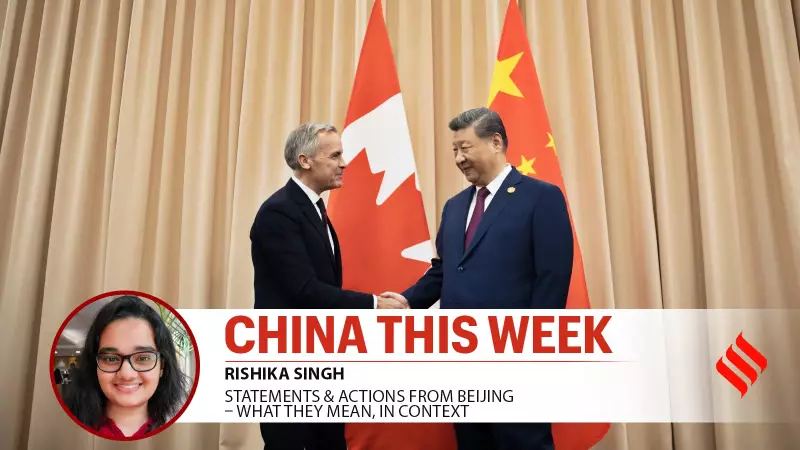
This weekly analysis provides comprehensive insights into significant developments emerging from China, focusing on three critical areas: military leadership scrutiny, evolving international diplomacy, and persistent demographic challenges.
Top Chinese Military Leaders Face Official Investigation
News about senior Chinese military leaders Zhang Youxia and Liu Zhenli coming under official investigation over the weekend has generated substantial reports and speculation regarding the reasons behind their removal. Zhang Youxia, aged 75, held the prestigious rank of general, making his targeting particularly significant within the ongoing process that has increasingly purged officials under ambiguous circumstances.
This development reinforces the perception that no individual within the Chinese military hierarchy is immune from scrutiny, potentially carrying broader ramifications for the People's Liberation Army as an institution. In numerous similar cases, verified concrete information from multiple sources and media outlets typically emerges only after considerable time has elapsed.

Nevertheless, the importance of Zhang's position and the various theories currently circulating warrant attention. This situation follows recent patterns highlighted in a report from the US Department of Justice last month, which documented expulsions and replacements within Chinese leadership structures.
Canada-China Diplomatic Thaw Amid Global Tensions
Carney's Beijing Visit and Strategic Partnerships
Canadian Prime Minister Mark Carney has captured international attention through his speech at the World Economic Forum meeting in Davos, where he advocated for middle powers to enhance collaboration during this era of "great power rivalry." He specifically mentioned establishing "new strategic partnerships with China and Qatar," signaling a strategic shift in Canadian foreign policy.
Carney's official visit to Beijing from January 14 to 17 marked the first Canadian prime ministerial visit in eight years, representing a notable thaw in bilateral relations that had experienced multiple irritants under former Prime Minister Justin Trudeau. These tensions included reciprocal tariffs, allegations of Chinese monitoring of Chinese-origin Canadian residents, and concerns about election interference attempts.
The diplomatic relationship had deteriorated to the point where both countries declared each other's envoys as persona non grata. However, the recent engagement has yielded agreements to settle longstanding trade issues and establish frameworks for major new investments. Bilateral trade between China and Canada reached $130.9 billion in 2024, providing substantial economic foundation for improved relations.
Trade Agreements and International Reactions
Under the new agreement, Canada has committed to providing "an initial country-specific quota of 49,000 electric vehicles per year at a most-favoured-nation tariff rate of 6.1%." In reciprocal measures, China will reduce tariffs on Canadian canola seeds, addressing a persistent trade concern.
These developments have drawn sharp criticism from US President Donald Trump, who threatened "a 100% Tariff against all Canadian goods and products" if Canada proceeds with agreements perceived as benefiting China. Trump characterized Canada as potentially becoming a "Drop Off Port" for Chinese goods entering the United States and issued stark warnings about Chinese economic influence.
Strategic Implications and Middle Power Diplomacy
There are clear strategic reasons for Canada and China to strengthen their bilateral relationship. Prime Minister Carney has distinguished himself among Western leaders by openly criticizing the United States under the Trump administration and advocating for greater interdependence among "middle powers." His response to Trump's assertion that "Canada lives because of the United States" with "Canada thrives because of Canadian values" reflects this independent diplomatic posture.

This alignment complements China's strategy of trade diversification following tariff implementations, including expanded engagement with developing nations. More broadly, China has positioned itself internationally as a more mature and responsible global actor compared to the United States. Chinese Vice Premier He Lifeng emphasized this positioning at Davos, speaking about Beijing's commitment to "a community with a shared future" and prioritizing "consensus and solidarity, and cooperation over division and confrontation."
China's Deepening Demographic Crisis
2025 Population Data Reveals Accelerating Decline
China's Statistics Ministry has released concerning population data for 2025, confirming the continuation of a contraction trend that began in 2022. The total number of births in 2025 plummeted to 7.92 million, representing a dramatic 17% reduction from 2024 figures. Simultaneously, the number of deaths rose to 11.31 million, creating a significant population deficit.
In response to these alarming trends, China has implemented various policies aimed at encouraging higher birth rates. Last year, the government introduced an annual nationwide subsidy of 3,600 yuan (approximately $500 or Rs 44,000) and removed condoms from the list of tax-exempt goods as part of broader pronatalist measures.
Structural Challenges and Historical Legacy
The reasons behind China's population decline extend beyond purely economic factors and reflect broader global patterns, though China's situation presents particularly stark challenges. Fewer births in any society create disproportionate pressure on the working population (ages 15 to 59) to support elderly dependents, resulting in increased tax burdens at a systemic level.
China's demographic crisis is exacerbated by the legacy of the mandatory One-Child Policy, which was enforced from 1979 to 2015. Adults born during this era now bear responsibility for supporting not only their parents but also two sets of grandparents, creating unprecedented multi-generational dependency ratios. As noted in analyses, "Decades of a one-child policy mean that the current generation of adults who are at child-bearing age are socially conditioned to favour single-child households."
Global Context and Policy Limitations
It is noteworthy that within a few decades, societal and public concerns have dramatically shifted from fears of overpopulation to anxieties about declining populations and birth rates. Beyond China's borders, similar demographic transitions have been attributed to increasing acceptance of individualistic aspirations, economic considerations, and women's enhanced autonomy regarding reproductive choices.
The scale of population decline across numerous countries with diverse cultures and economic conditions, combined with the limited effectiveness of policies designed to incentivize childbearing, invites deeper examination of these global demographic trends. China's experience provides a particularly significant case study in how historical policies can create long-term structural challenges that resist straightforward policy solutions.