China's State Media Launches Sharp Critique of US Military Actions in Iran
Chinese state media has unleashed a pointed critique against Washington's military campaign in Iran, employing vivid imagery and biting satire to portray the conflict as both devastating and hypocritical. The campaign comes as violence intensifies across the region, with significant geopolitical and economic implications.
Stark Visuals: From Playgrounds to Battlefields
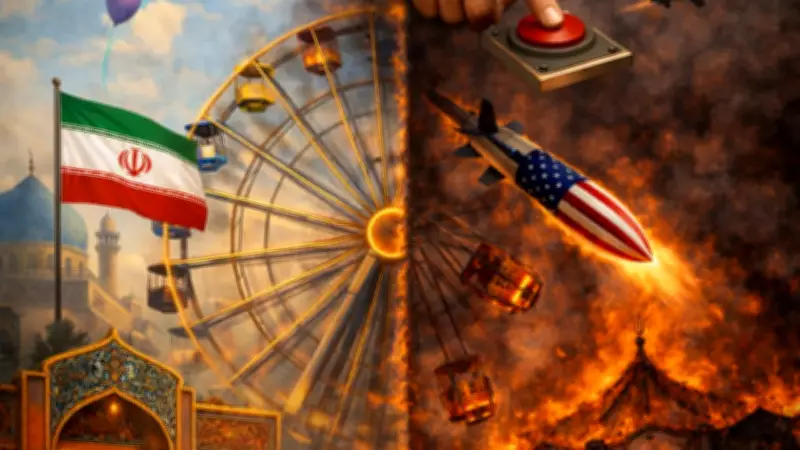
In a powerful post, China's official Xinhua News Agency shared a split image depicting a children's playground. One side showed swings and slides standing peacefully under clear skies, while the other presented the same scene shattered, engulfed in flames and missiles. The caption, "A Children's Playground Turned into a Bloodstained Tomb," served as a direct visual link between US military operations and civilian devastation, aiming to evoke emotional responses and highlight humanitarian concerns.
Satirical Videos and Cartoons Target US Policies
Another widely circulated post featured a stylized video of a bald eagle, a symbol of the United States, singing a song with the refrain: "Go my way, you might be fine; go your way, you'll pay the price." The lyrics chronicled decades of US-Iran relations, from 1950s coup-era politics to sanctions and the collapse of the nuclear deal, bluntly messaging that Washington punishes defiance and rewards compliance.

China Central Television (CCTV) amplified the campaign with a series of cartoons. One depicted a hospital patient, representing the United States, boasting, "We're winning so much they are begging to negotiate," prompting a doctor to order a nurse to "double the dose." This implied that perceived US victories are fueling further escalation rather than promoting restraint. Another cartoon showed "Uncle Sam" with an ever-growing nose, accusing the US of buying time "with a string of lies" amid mounting domestic and international pressure.
Escalating Conflict and Global Repercussions
The messaging coincides with a worsening war. Former US President Donald Trump recently expressed frustration at allies unwilling to back Washington more forcefully, telling them to "go get your own oil" as global energy markets reel. US strikes on Iranian targets, including areas near key nuclear facilities like Isfahan, have triggered retaliatory attacks by Tehran, such as drone strikes on oil infrastructure in the Gulf.
More than a month into the conflict, over 3,000 people have been killed, with violence spreading across Iran, Israel, Lebanon, and parts of the Gulf. The Strait of Hormuz, through which a fifth of the world's oil passes, has become a flashpoint, driving crude prices sharply higher and unsettling global markets.
Beijing's Cautious Diplomatic Stance
Despite its rhetorical barrage, Beijing's approach remains measured. China relies on Iranian oil but maintains far deeper economic ties with Gulf states like Saudi Arabia and the UAE. Analysts note that China's priority is stability: keeping energy flows open while positioning itself diplomatically as a voice for restraint, balancing its critiques with pragmatic economic interests.
This media campaign reflects broader geopolitical tensions, as China uses state-controlled platforms to challenge US actions and advocate for its vision of international relations, all while navigating complex regional dynamics.