Middle East Conflict Severely Impacts Dubai's Tourism and Airline Operations
The ongoing war in the Middle East has dramatically drained Dubai of its travel appeal, creating a significant crisis for the region's aviation industry. Emirates, recognized as the world's largest international airline, is currently operating numerous flights to Dubai with alarmingly low occupancy rates. Travelers are actively avoiding the Persian Gulf region due to safety concerns and escalating tensions, leading to a sharp decline in passenger numbers.
Planes Flying Nearly Empty Across Key Routes
Internal data compiled by Emirates and reviewed by Bloomberg reveals a stark picture of the airline's current challenges. Flights originating from the United States and continental Europe have been hit the hardest, with occupancy on several critical routes dropping precipitously. The carrier is facing immense difficulties in restoring its global network amidst the intensifying conflict between Israel and Iran, which has broader regional implications.
Specific occupancy data highlights the severity of the situation:

- Planes returning from European hubs like Prague or Budapest are carrying only 5% to 10% of their passenger capacity.
- Several aircraft departing from New York have flown with just one-fifth of tickets sold.
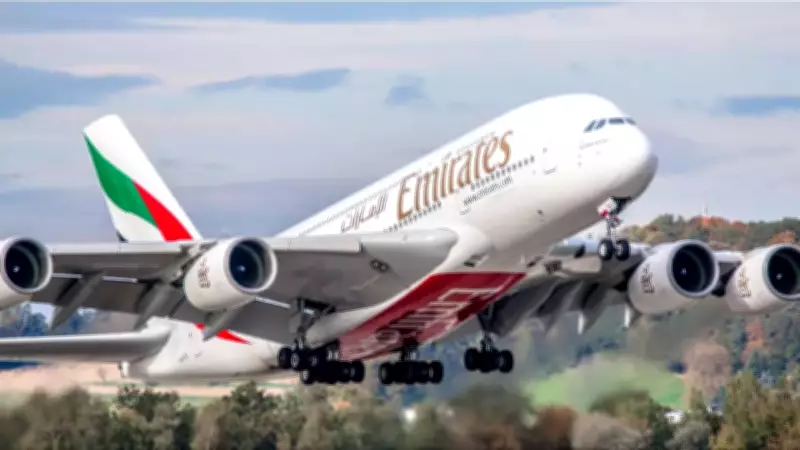
- At least one Airbus A380 superjumbo departed last week with fewer than 35 passengers on board—a jet designed to seat nearly 500 people.
- Departures from Chicago have been operating with half-empty cabins.
- On a Paris-Dubai flight, an Airbus A380 configured to seat about 600 passengers carried only around 25 individuals, nearly matching the number of crew required to operate the aircraft.
London Heathrow departures have fared slightly better, but still significantly below normal levels, with only about 20% of tickets sold. This is far below Emirates' usual near-full occupancy on its dozen daily services to the United Kingdom. Forward bookings for inbound flights to Dubai are currently around one-third of capacity, which is unusually low given the approaching busy Easter travel season.
Operational Disruptions and Daily Challenges
Emirates is confronting several thousand daily no-shows on outbound flights, according to an internal memo. This highlights the immense complexity of running an operation that typically includes hundreds of daily flights operating at near-full capacity. The airline has responded by offering refunds and flexible rescheduling options for flights until the end of the month to accommodate wary travelers.
"Given the circumstances, current inbound occupancy is unsurprisingly light," an Emirates official stated in comments to Bloomberg. The airline emphasized its commitment to continue restoring its network at pace, provided it can do so safely for passengers and crew.
Operations have been repeatedly disrupted by direct security threats, including Iranian missile warnings and several drone incidents near Dubai International Airport. These incidents have caused minor injuries and some property damage since the conflict began. On one recent Monday, Emirates was forced to suspend operations for more than seven hours following a fuel-tank fire triggered by a drone strike, before cautiously resuming flights later the same day.
Cargo Becomes Critical Revenue Stream
While passenger demand remains severely weakened, Emirates is partially offsetting losses by carrying cargo, including perishable goods. This generates crucial alternative revenue during this period of reduced travel. The airline is prioritizing its Boeing 777 fleet for certain routes because these aircraft offer more optimal cargo capacity compared to the larger Airbus A380s.
With the strategically vital Strait of Hormuz effectively closed to normal maritime traffic due to security concerns, Emirates flights have become one of the few reliable methods to import essential supplies into the region. This unexpected role underscores the airline's importance beyond passenger transport during the crisis.

Competitive Landscape and Outbound Traffic
Other major Gulf carriers, including Etihad Airways and Qatar Airways, have resumed operations but with a significantly thinned-out service schedule. Their current focus is primarily on evacuating stranded passengers from the region. In contrast, Emirates continues to operate at a much faster pace than its competitors, offering at least six times as many flights as Qatar Airways. However, this expanded schedule comes with its own logistical challenges, as some Emirates aircraft remain out of position in Europe and China, unable to return to their Dubai hub efficiently.
Interestingly, flights leaving Dubai present a different narrative. Passenger departures from the city continue, despite fewer planes being available, indicating that while inbound tourism has collapsed, outbound travel and resident departures persist. This creates an unusual asymmetry in the airline's traffic flows.
The situation remains fluid and highly dependent on geopolitical developments. The conflict's ripple effects are reshaping travel patterns in the Gulf, with Dubai's tourism-dependent economy facing one of its most significant challenges in recent years. The coming weeks will be critical for Emirates as it navigates this unprecedented operational environment while maintaining safety as its paramount concern.