From an Amazonian river that literally boils to a Polish forest full of weirdly warped pines, these spots let you step right into that fuzzy line between cold hard facts and local folklore. Science has cracked a few of these cases, but others remain partially steeped in mystery, offering travelers a genuine sense of wonder.
The Devil's Cauldron, Minnesota, USA
Tucked away in Judge C.R. Magney State Park on the edge of Lake Superior, the Devil's Cauldron is one of North America's weirdest natural puzzles. Where the Brule River splits in two, one side flows like a normal waterfall, but the other drops into a massive pothole and seemingly vanishes. For years, no one knew where the water ended up, despite tossing logs, dye, and other objects downstream. Wild theories about secret underground cave systems abounded until researchers solved the puzzle in 2017. By measuring water flow above and below the falls, they discovered the vanished water rejoins the river further down, trapped beneath the surface by incredibly strong currents. Visitors can fly into Duluth International Airport and drive up Minnesota's North Shore to the state park, then hike a 2.5-mile round trip to the falls. Spring and autumn offer the best views.
The Alaska Triangle, USA
Spanning 200,000 square miles between Anchorage, Juneau, and Utqiagvik, the Alaska Triangle has a reputation as North America's premier vanishing act. Thousands of people—hikers, pilots, and even whole airplanes—have disappeared here over decades. Locals tell stories of shape-shifters and supernatural spirits, while newer theories involve UFOs and magnetic anomalies. Scientists point to Alaska's brutal weather, massive glaciers, rugged mountains, and sheer scale, making it easy for crash sites to be swallowed by the landscape. Anchorage is the best starting point for wilderness expeditions, sightseeing flights, or national park tours, but exploring without a seasoned guide is strongly discouraged.

The Zone of Silence, Mexico
Where the Mexican states of Durango, Chihuahua, and Coahuila meet lies the Zone of Silence, a desolate desert where compasses spin, radio signals die, and bizarre encounters occur. Things escalated in 1970 when a US military test rocket crashed there, and the secretive clean-up fueled rumors of a freak magnetic force. Since then, stories of floating lights, weird strangers, and communication blackouts have emerged. Researchers found no magical force fields but noted unusual mineral deposits and meteorite fragments that can disrupt instruments. Visitors can reach the area from Durango or Chihuahua with a sturdy four-wheel-drive, but guided tours are safest due to the unforgiving desert.
The Boiling River, Peru
Deep in the Peruvian Amazon, the Shanay-Timpishka, or Boiling River, reaches near-boiling temperatures despite being hundreds of kilometers from the nearest active volcano. For local Indigenous communities, it is a sacred place tied to the serpent spirit Yacumama, Mother of the Waters. Scientists discovered that rainwater seeps deep into the earth through fault systems, gets superheated by geothermal energy, and pushes back to the surface. To visit, fly into Pucallpa, take a road to Honoria, then continue by boat and jungle trek, typically arranged through local guides or eco-lodges.
The Walking Stones, California, USA
On the Racetrack Playa in Death Valley National Park, heavy rocks appear to move on their own, leaving drag marks across cracked mud. Geologists were stumped for decades until 2013, when researchers caught them in action during freezing winter conditions. Wafer-thin sheets of ice form on the playa, and gentle winds shove these ice panels, nudging the rocks through slippery mud. Visitors need a high-clearance vehicle to brave the rough dirt road to the Racetrack, and should avoid extreme summer heat.
The Baltic Sea Anomaly
In 2011, Swedish explorers discovered a massive, perfectly circular structure on the ocean floor, sparking comparisons with crashed spaceships. Divers reported equipment failures, fueling sci-fi theories. Geologists later concluded it is a natural rock formation carved by glacial activity during the last Ice Age. The anomaly sits 90 meters deep between Sweden and Finland, accessible only by specialized technical diving expeditions.

The Eye of the Sahara, Mauritania
Visible from space, the Eye of the Sahara, or Richat Structure, is a 40-kilometer-wide bullseye in Mauritania's Adrar Plateau. Initially thought to be an impact crater or the lost city of Atlantis, geologists determined it is a deeply eroded geological dome built over millions of years. To visit, fly to Nouakchott, then travel to Atar or Ouadane, and join guided 4x4 expeditions across the desert between October and April.
The Crooked Forest, Poland
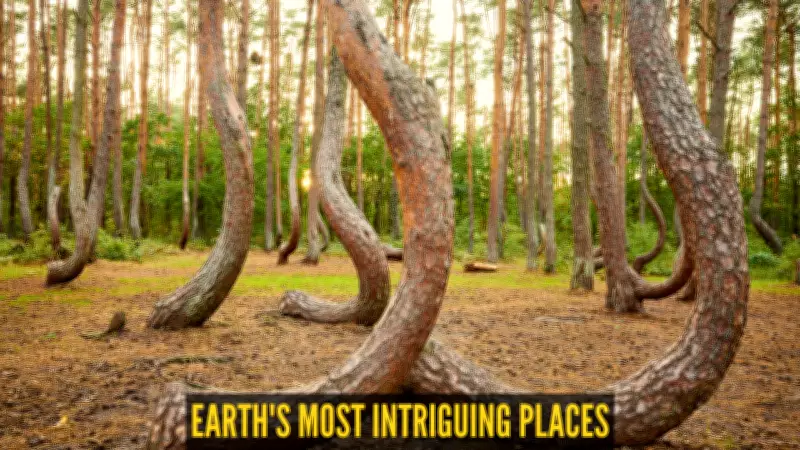
Near the village of Nowe Czarnowo in western Poland, a grove of about 400 pine trees has every trunk sharply bent near the base before curving back up. No one knows exactly why—theories range from strange weather to WWII military activity, but the most popular guess is that local foresters purposefully warped young trees to grow curved timber for boats or furniture. No records were left, so the mystery endures. It is easily reached from Szczecin by train to Dolna Odra station, then taxi or walk.