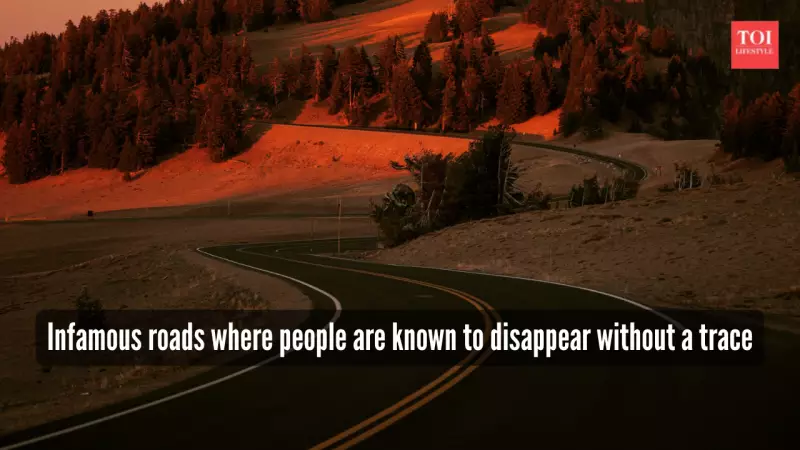
Some roads are remembered not for the journeys they enable, but for the travellers they claim. Across the globe, certain highways have become infamous for a chilling pattern: people vanishing during seemingly ordinary trips. No crash scenes, no clear evidence of crime—just empty vehicles and unanswered questions. These are not tales from folklore, but documented cases where isolation, terrain, and circumstance conspire to create enduring mysteries.
The Highways of Haunting Disappearances
Investigators often find vehicles abandoned with doors unlocked, keys in the ignition, and engines cold, suggesting the occupants stopped voluntarily. Yet, what happened next remains a puzzle. There is typically no sign of mechanical failure, no definitive crime scene, and no single theory that explains all cases. The unsettling reality is that on these specific routes, disappearance is a repeated, documented fact.
1. Highway of Tears, British Columbia, Canada
This refers to a remote section of Highway 16 between Prince George and Prince Rupert. Since the 1970s, numerous individuals, a disproportionate number of them Indigenous women, have gone missing or been found murdered along this corridor. Many were last seen hitchhiking due to limited public transport in the isolated region.

The cases are deeply troubling because victims often vanish completely, with their vehicles never recovered. Despite dedicated task forces and public inquiries, many crimes remain unsolved. Authorities acknowledge that the vast distances between towns, extreme isolation, and lack of surveillance have been major factors.
2. Clinton Road, New Jersey, USA
Winding through dense forest in West Milford, this narrow 10-mile road has a dark reputation fueled by local legends. Stories circulate about paranormal activity, ghost sightings, strange creatures, and gatherings by occult groups. It is also rumoured to be a body dumping ground for criminals, with at least one documented incident supporting this claim.
The road has been frequently featured in publications like Weird NJ. A local police chief once described it as “a long, desolate stretch that easily fuels the imagination.”
3. US Route 491 (Formerly Route 666), USA
Traversing sparse desert regions in New Mexico, Arizona, and Colorado, this route earned the nickname “Devil’s Highway” due to its original number's association with the biblical Number of the Beast. The ominous reputation led to stolen highway signs and tales of strange occurrences.
One USA Today report quoted an unnamed officer recalling a suspect who claimed, “Triple 6 is evil. Everyone dies on that highway.” However, skeptics note that fatality rates are average or lower in most stretches, except in New Mexico, where poor road design is considered the likely culprit for higher accidents.
4. The Darién Gap, Pan-American Highway (Panama–Colombia)
This is the only break in the Pan-American Highway—a treacherous region of dense jungle, swamps, and mountains with no continuous road. For years, the area was influenced by the Revolutionary Armed Forces of Colombia (FARC) insurgency.
Many who attempted to cross have disappeared. In 1993, three New Tribes missionaries vanished on the Panamanian side and were later confirmed dead. In May 2013, Swedish backpacker Jan Philip Braunisch disappeared after setting out from Colombia to cross into Panama on foot. The FARC later admitted responsibility, stating they mistakenly identified him as an intelligence operative.
5. Stuart Highway, Northern Territory, Australia
Cutting through Australia's vast, arid interior, the Stuart Highway presents a landscape of extreme isolation. There are documented cases of solo travellers vanishing without explanation.
In some investigations, footprints were found leading away from the road before disappearing into the desert. The sheer scale of the terrain means a person who leaves their vehicle can succumb to the elements within hours, leaving behind minimal evidence for recovery teams.

The Common Thread: Isolation and Consequence
The danger of these roads does not stem from superstition. It arises from a deadly combination of immense distances, harsh terrain, profound isolation, and slow emergency response times. In such environments, a single small decision—a wrong turn, a stopped car, a step into the wilderness—can lead to irreversible and mysterious consequences. The true mystery lies not in imagined horrors, but in the stark, unresolved reality of what was never found.