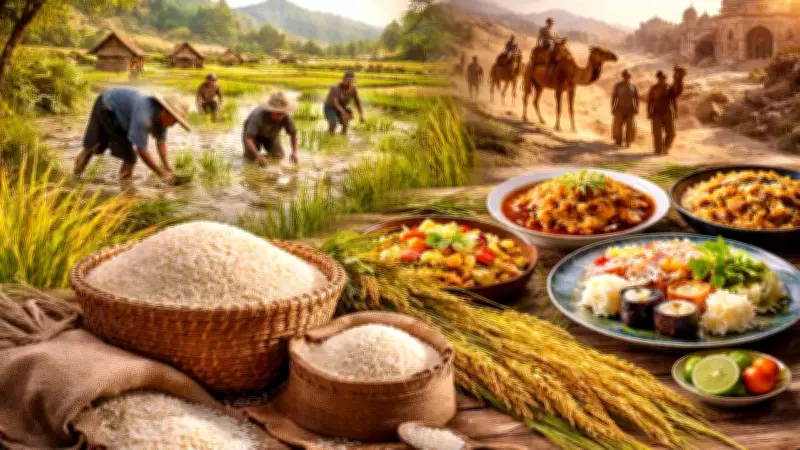
The Global Staple: Rice's Journey Through Millennia
Rice stands as one of the most universally consumed foods on the planet, forming an essential component of daily nutrition for billions of individuals worldwide. From the simple dal-chawal combination in India to Japan's delicate sushi and Spain's vibrant paella, this versatile grain has seamlessly integrated itself into diverse culinary traditions across the globe.
Ancient Origins in China's Yangtze Valley
The remarkable ascent of rice from a wild plant to a dietary cornerstone spans thousands of years, with its origins tracing back to ancient China. Archaeological evidence indicates that rice domestication began approximately 9,000 years ago in the fertile Yangtze River Valley, where it served as one of humanity's earliest cultivated food sources.
A comprehensive study titled "Archaeological and genetic insights into the origins of domesticated rice", published in the prestigious Proceedings of the National Academy of Sciences (PNAS), presents compelling archaeological and genetic data confirming that rice cultivation originated in China around nine millennia ago. The region's rich soil and abundant water resources created ideal growing conditions, with rice demonstrating unique adaptability to muddy environments where other crops would struggle.

Early civilizations quickly recognized the significance of this resilient plant, which provided substantial nutritional value, could be easily stored for extended periods, and required relatively simple preparation methods compared to other contemporary food sources.
Expansion Across Asia and Beyond
The widespread consumption of rice in ancient China facilitated its gradual dissemination throughout Asia via migration patterns and established trade networks. This was not an instantaneous process but rather unfolded over centuries as cultural exchanges increased between regions.
Genetic research published in Nature journal, under the title "A map of rice genome variation reveals the origin of cultivated rice", demonstrates that domesticated rice varieties originated in southern China before spreading systematically to South and Southeast Asia, including the Indian subcontinent. Upon reaching India, rice found exceptionally favorable growing conditions, particularly benefiting from the region's predictable monsoon cycles that supported its cultivation as a primary staple crop.
Rice Conquers the World
By approximately the 7th century, rice began appearing in Western cultures through established trading routes, first reaching Persia before gradually spreading throughout Europe. During the Age of Exploration and subsequent global trade expansion, rice traveled to Africa and the Americas, where each culture embraced the grain and developed distinctive culinary traditions centered around its preparation.
Today, rice serves as a fundamental food source for more than 50% of the global population, contributing significantly to total caloric intake worldwide. Its universal adoption stems from several key advantages:
- Remarkable adaptability to diverse climatic conditions, particularly thriving in flooded paddies where other grains fail
- Substantial nutritional value combined with affordability
- Exceptional versatility in preparation methods, from simple steaming to complex culinary creations
- Relative ease of cultivation and storage compared to many alternative crops
Cultural Significance Beyond Nutrition
Beyond its nutritional importance, rice carries profound cultural meaning across numerous societies. In India, while rice forms part of daily sustenance, it also features prominently in religious ceremonies and festive celebrations. For Japanese culture, rice transcends mere sustenance to embody cultural identity and traditional values. In various global communities, rice symbolizes prosperity, abundance, and social cohesion.

For thousands of years, rice has evolved from a basic food item to an integral component of human civilization, representing the interconnectedness of cultures across time and geography. The journey of this humble grain—from its origins in a Chinese river valley to becoming a worldwide dietary essential—illustrates humanity's shared agricultural heritage and our collective dependence on sustainable food systems.