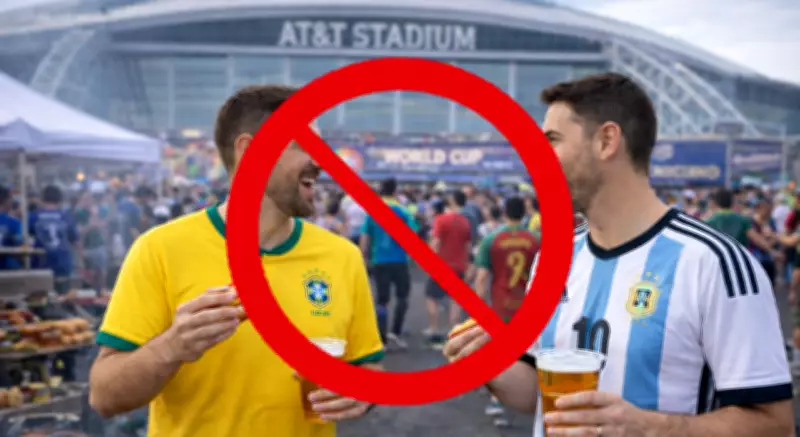
FIFA's 2026 World Cup Plan Clashes with American Tailgating Tradition
For countless travelers heading to the United States for the 2026 FIFA World Cup, the vision of an American matchday is already vividly painted in the mind. It is an image forged by Hollywood and lived experience: sizzling hot dogs on portable grills, coolers overflowing with chilled beverages, background music setting the tone, with tents and pickup trucks lining expansive parking lots hours before the opening whistle. If a television is present, it is often perched precariously between a car bumper and a folding chair, broadcasting earlier matches as a communal backdrop. Crucially, this experience does not require a stadium ticket for participation; it simply demands one's presence.
The Unofficial Ritual Versus Official Control
This deeply ingrained version of the sporting day has historically operated in a parallel space alongside the official stadium experience. It belongs not to the league, the venue, or the tournament organizers, but fundamentally to the people who create it. However, this iconic element of American sports culture is poised to be conspicuously absent at the 2026 World Cup hosted across the United States, Canada, and Mexico.
Multiple reports confirm that FIFA intends to prohibit traditional tailgating at several major U.S. venues, including MetLife Stadium in New Jersey, Arrowhead Stadium in Kansas City, and Gillette Stadium in Massachusetts. Parking at key sites, particularly MetLife, is expected to face severe restrictions or be entirely unavailable. In its stead, supporters will be directed towards organized, ticketed fan zones and hospitality areas—spaces designed for control, management, and revenue generation.

FIFA has yet to provide a detailed public rationale for this significant policy shift. The reasoning must be inferred from the tournament's expansive structure and the logistical challenges it aims to preemptively address.
Logistical Pressure Points of a Transnational Tournament
The 2026 World Cup represents an unprecedented logistical undertaking, spanning three nations and 16 host cities, with the United States staging 11 venues and hosting the majority of matches, including all fixtures from the quarter-finals onward. The tournament opens officially in Mexico City on June 11, 2026, with the first U.S. match scheduled for June 12 at SoFi Stadium in Los Angeles.
Many American stadiums selected, such as AT&T Stadium in Texas, NRG Stadium in Houston, and Levi's Stadium in California, were constructed in suburban locales over recent decades. Their design philosophy centers on automobile access, featuring vast surrounding parking lots.
This infrastructure functions differently under the intense, concentrated pressures of a World Cup. Instead of the typical staggered arrivals over several hours for domestic league games, enormous numbers of international supporters will converge within tighter timeframes, compounded by enhanced security protocols and travel complexities. Parking areas that normally absorb vehicular flow can rapidly transform into unmanageable congregation points once filled to capacity.
The recent memory of the 2024 Copa América in Miami serves as a cautionary tale. Outside Hard Rock Stadium, large, unstructured crowds created severe bottlenecks and delays, forcing organizers to contend with a major crowd management challenge exterior to the stadium itself.
The Cultural and Economic Significance of American Tailgating
Tailgating in the American context transcends mere pre-game dining; it is an integral ritual that defines the matchday experience. Fans gather in stadium parking lots, transforming the backs of SUVs and trucks into makeshift social hubs complete with grills, coolers, sound systems, and occasionally portable televisions. Arriving hours early, they establish a communal space where atmosphere builds organically, long before passing through the stadium gates. It is a tradition of meeting, repetition, and shared routine.

The practice also carries substantial practical and economic weight. For mega-events like the World Cup, tickets are notoriously expensive and scarce. Gathering with friends outside the venue, setting up a viewing area, and absorbing the ambient crowd noise has long served as a legitimate and cherished form of participation—a way to be part of the event without securing costly entry. For many, it is the only viable method of attendance.
This social ritual boasts a history longer than the modern stadiums it surrounds. Historians trace a proto-tailgate event to July 21, 1861, when Washington residents traveled by carriage to Virginia to witness the First Battle of Bull Run, picnicking while listening to distant artillery. By 1869, similar behavior was documented at early college football games between Rutgers and Princeton, where spectators enjoyed picnics from their wagons. Reports from the 1880s describe Yale-Princeton crowds partaking in food and drink from horse-drawn coaches, marking the early evolution of this distinctive American social viewing tradition.
The Mounting Financial Burden for Supporters
Compounding the cultural shift, the hidden costs of attending the 2026 World Cup are projected to rise sharply. Beyond ticket prices, which for marquee matches can reach thousands of dollars, transportation expenses on matchdays are expected to skyrocket.
Public transit systems are anticipated to shoulder a heavier burden, with fares set to increase dramatically in host cities. For instance, travel from New York Penn Station to MetLife Stadium in New Jersey, typically under $13, is forecasted to exceed $100 during the tournament. In the Boston area, journeys to Gillette Stadium have been preliminarily priced around $80, with dedicated bus options potentially reaching $95.
Contrasting Approaches from Recent World Cups
Recent World Cup host nations have managed crowd movement and logistics with a different, more integrated philosophy than what is currently emerging for the 2026 U.S. edition.
At the 2022 FIFA World Cup in Qatar, transport was seamlessly woven into the tournament's fabric. Ticket holders received free access to the Doha Metro, buses, and trams via the Hayya Card system, with clear routing between compact stadiums and official fan zones.
A similar model was employed during the 2018 FIFA World Cup in Russia. Supporters who registered for a Fan ID were granted free urban transport within host cities and access to over 700 additional long-distance trains connecting venues. Complex inter-city travel was effectively absorbed into the tournament's operational structure, eliminating the need for fans to arrange separate logistics.
In both cases, supporter activity was largely confined to three spaces: in transit, inside designated fan zones, or within the stadiums themselves. The immediate areas surrounding the venues remained under tight control.
The United States presents a distinct challenge to this model. Its stadiums are often situated at a distance from dense public transit networks, and the culture that has organically developed—centered on tailgating—has historically filled that logistical and social gap. Current planning for the 2026 World Cup suggests this deeply rooted cultural nuance may not have been fully incorporated into the matchday strategy, potentially creating friction between global tournament protocols and local fan traditions.