Korean Street Food Thelas: The New Craze Sweeping Indian Cities
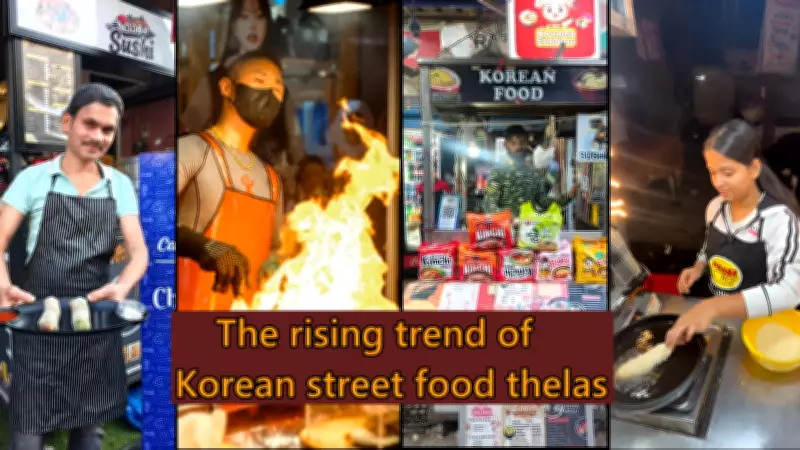
Move aside momos and chaat, as Korean street food thelas are rapidly becoming the new rage across Indian metropolitan cities. Kiosks offering staples like ramen, buldak, and corn dogs are capturing the hearts and taste buds of Gen Z and Alpha, marking a significant shift in urban street food culture.
A Surprising Sight in Delhi Markets
While strolling through a bustling market in Delhi, an unexpected cart caught my attention. It stood out with colorful food packets, animated sketches, an unfamiliar fragrance, and scribbles in a foreign language. To my surprise, it was a Korean street food thela, bringing East Asian delicacies right next to traditional gol gappa and momo stalls.
The menu, displayed on a curry-stained plastic pamphlet, featured items like corn dog, kimchi ramen, shin ramen, buldak, and laphing. At Hassh Laphing Point in East Delhi, Akshat Jain, along with college friends Samridhi Kumari and Ajeet Poddar, shared their journey. "We started five months ago with just one study table. Initially slow, we gained fame through Instagram, and now many come to try our Korean dishes," Jain said proudly.

Spreading Across Metropolitan Cities
This is not an isolated success. Social media algorithms reveal similar carts in cities like Pune and Bengaluru, indicating a growing nationwide trend. In Delhi's Rajouri Garden market, Q'nnas, a fast-food joint, serves Chinese, Continental, and Korean food together, attracting diverse crowds.
Tanisha Gupta, visiting with her 12-year-old son Anshul, noted, "Bachchon mein kaafi craze hai Korean food ka." Anshul added, "I love the flavor! Fresh ramen here beats ready-to-eat packets." Clearly, Korean cuisine is becoming a new normal for younger generations.
The Cultural Connection: K-Pop and K-Dramas
Suman Gupta highlighted her daughter Anushmita's fascination, "She is part of the BTS Army." Anushmita, enjoying a popping boba mojito, confessed her love for BTS and K-pop fuels her excitement for these visits. Foodpreneur Biraja Rout explained, "Gen Z and Alpha consume South Korean content—K-pop, K-dramas, reality TV, skincare—making Korean eating habits familiar and aspirational."
Myong Kil Yun, Regional Director at Korea Tourism Organization, emphasized this trend, "Food becomes a gateway to travel, helping people see Korea as a tangible destination through its cuisine."
Affordability and Accessibility Driving Growth
Beyond cultural influences, affordability plays a key role. Korean dishes are priced similarly to Indian chaats and gol gappas, making them accessible. Monika Gupta, an HR professional, said, "Restaurants are expensive; these carts are perfect for trying Korean flavors." Gurmeet Choudhary added that local carts reduce travel time, unlike distant spots like Majnu Ka Tila.
The Desi Fusion Twist
Authenticity takes a backseat to adaptation. Vishal, chef at Korea Station, noted, "We tweak flavors slightly for local palates." Sales peak between 8 pm and 10 pm, aligning with Indian street food hours. Samridhi Kumari of Hassh Laphing Point shared, "It took months to perfect; the flavor is 90% authentic with gluten-free homemade ingredients."
Rout explained, "Korean food retains identity with local changes—gochujang heat softened, spice levels dialed up, cheese added generously." Chetan Raj, Executive Sous Chef at The Claridges, pointed out, "Korean cuisine's subtle umami contrasts with bold Indian flavors, making it refreshing."
A Cultural Shift on Our Streets
This fusion is not shocking; street food thrives on translation. Rout said, "Just as chowmein evolved in India, Korean ramen is becoming a hybrid here." While it's early to predict if it will rival Chinese fast food or threaten traditional vendors, each bowl of ramen or corn dog represents a spicy slice of cultural shift etching into food history.