

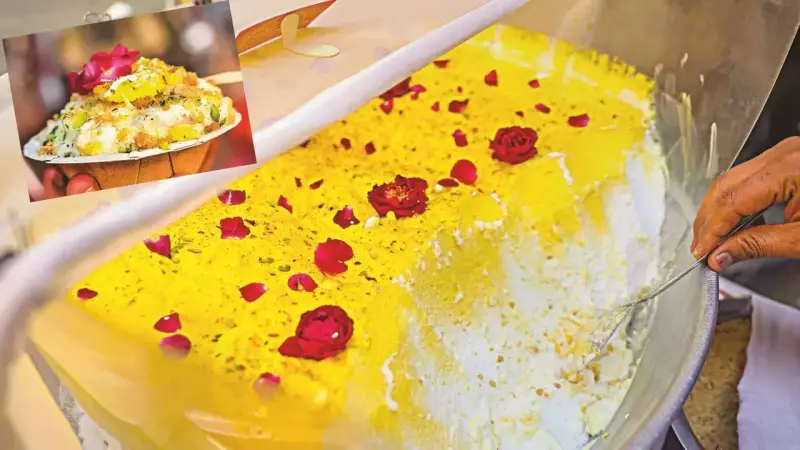
As most of Delhi slumbers past midnight, 55-year-old Khemchand and his sons begin their day. At 1:30 AM, with winter dew settling, they start churning 20 litres of milk mixed with 8 kilos of cream. Using a traditional mathani (hand-churning tool), they take turns in slow, circular motions—a labour that stretches from midnight until sunrise.
From Dawn to Chandni Chowk: A Four-Decade Ritual
By 8 AM, their effort transforms the liquid into an airy, delicate froth—the base of the famed Daulat Ki Chaat. By 10:30 AM, carrying shallow, wide vessels (parats) brimming with the fragile delicacy, they head to the bustling lanes of Chandni Chowk. Khemchand positions himself at Nayi Sadak's entrance, while his sons park their pushcarts in the famous Gali Paranthe Wali. This ritual has remained unchanged for Khemchand for nearly 40 years.
Not far away, vendor Rakesh Gupta represents a modern shift. His family has been in the business for 60 years, but he now uses refrigeration for the labour-intensive churning. He prepares batches inside his shop, assembling each serving fresh when a customer arrives. This contrast highlights the evolution of a dish that has journeyed from dusty Chandni Chowk thelas to fancy plates adorned with fake currency notes in upscale restaurants.

A Dish of Many Names and Contested Origins
Contrary to popular belief, Daulat Ki Chaat is not a traditional Delhi creation. Food historian Pushpesh Pant clarifies its origins. "It is not Delhi's seasonal winter food at all," he asserts. "The historical origins of this chaat are from Lucknow, where it was called Nimish. In Kanpur, it is Makhan Malai, and in Banaras, Malaiyo." The name 'Nimish' means one-eighth of a blink of an eye, referring to how quickly the froth settles.
The dessert arrived in Delhi relatively late, most likely in the late 19th or early 20th century. Its exact journey is debated: some say it travelled with the Botai tribe from Afghanistan, while others believe Arab traders brought it via the Silk Route. The name 'Daulat' (wealth) wasn't invented by a halwai named Daulat. As Khemchand explains, it was once a royal indulgence for rajas and maharajas—"Pehle raeeson ka sauda tha"—hence a chaat so luxurious it named itself 'wealth.'
Seasonal Loyalty vs. Modern Shortcuts
The making of Daulat Ki Chaat is intrinsically tied to winter. Rakesh Gupta sells it only in the cold months, a rule he swears by. "Jis cheez ka jo mausam hai, ussi mausam mein achha lagta hai," he says, switching to kulfi when temperatures rise. Hukum Singh, a vendor from UP, echoes this sentiment, comparing the dessert to seasonal fruit.
However, not everyone follows this seasonal code. Both Gupta and Pant point out that several vendors now use shortcuts, like cream of tartar or other chemicals, to stabilize the froth beyond winter. "(Kuch log) chemical daal dete hain toh mehnat nahi karni padti," says Gupta, noting that while their traditional process costs up to ₹4,000, chemical-aided preparation can be done for just ₹200. Pant frames this as part of a larger shift where refrigeration and mechanisation have made seasonal, aristocratic foods accessible year-round.
Evolution in Pricing, Presentation, and Patronage
The business has evolved significantly over the decades. Khemchand, who took over from his father in the early 1980s, once sold a plate for ₹2; it now costs ₹100. Hukum Singh sells it for ₹80-₹100, though he laments poor sales this year following the Red Fort blast incident, stating, "Sale bahut kam hai."
The selling pattern has also changed. "Earlier, I used to leave from my home at 7am... Pehle gali-gali jaate thay," recalls Khemchand. Now, they leave around 10-10:30 AM, and their business is directly tied to the footfall in Chandni Chowk's market.

The most dramatic transformation, however, is in its presentation and clientele. In 2012, celebrated chef Manish Mehrotra decided to bring Daulat Ki Chaat from Chandni Chowk's bylanes to the fine-dining tables of Indian Accent. He added almond sparkle and rose petal chikkis, presenting it on plates with fake currency notes to emphasise the 'daulat' (wealth) theme. "The world was talking about foams and molecular food, but India had been doing it for 100 years," says Mehrotra.
Thanks to technology like food siphons, he can now offer it even in summer. Does this modernisation kill authenticity? Mehrotra disagrees, arguing that not updating dishes for new generations leads to extinction. "At heart, it should be the traditional stuff. You can play with the presentation... but the essence of the dish should remain the same," he asserts. Today, the humble chaat has graced events like the Ambani wedding and Sonam Kapoor's dinner for David Beckham, making a grand comeback among modern aristocrats while still being rooted in its delicate, frothy essence.





