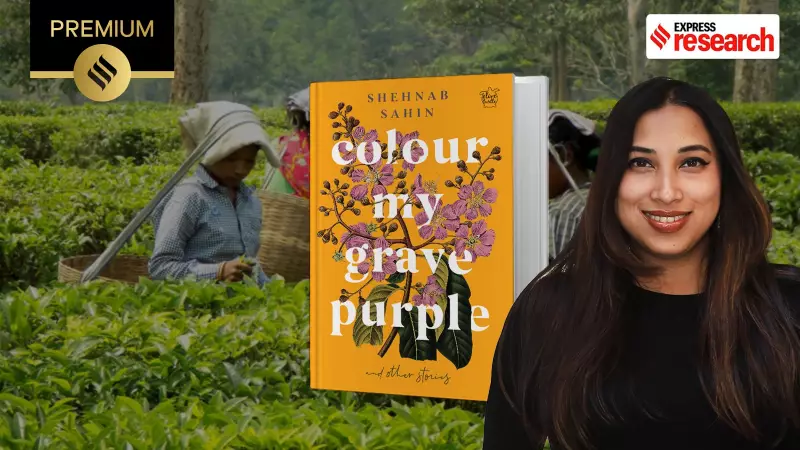
Shehnab Sahin's debut short-story collection, Colour My Grave Purple and Other Stories, offers a fictional yet deeply researched window into Assam's often overlooked historical episodes, ranging from the aftermath of the Opium Wars to the 1962 Tezpur invasion during the India-China war. Published by Niyogi Books, this work aims to broaden the narrative of Assam beyond its common associations with insurgency and the Armed Forces (Special Powers) Act (AFSPA), delving into social transformations shaped by tea, migration, and colonial policies.
Exploring Assam's Multifaceted Past Through Fiction
The collection opens in 1858 amidst Assam's teeming tea plantations, a setting influenced by the Opium Wars in China. The first story, Tea Leaves and a Bud (1858), centers on Samuel Paddington, a British botanist-turned-estate manager, and his Cantonese wife, highlighting interactions with plantation workers. This narrative introduces readers to a 19th-century social landscape reshaped by the commercialization of tea, the arrival of British and Chinese migrants, and a plantation economy that reordered society.
Connecting Local and Global Histories
Across ten stories, Sahin, a former Assam government civil servant and humanitarian aid worker, weaves forgotten historical fragments into compelling fiction. The collection spans lesser-told episodes, such as the impact of the British ban on private opium cultivation, the threat of Japanese invasion during World War II, and the Chinese advance into Assam in 1962. In an interview, Sahin emphasizes her goal to link Assam not only to mainland India but also to wider global currents, contesting the overemphasis on violence in English-language fiction from the region.

Author's Inspiration and Creative Process
Sahin began writing during the COVID-19 pandemic while serving as an assistant commissioner with the Assam government. Motivated by a desire to trace the Assam of her father's time, she used writing as an exercise in retention, drawing from memory to explore themes like tea, opium, human-animal conflict, and anti-colonial rebellions. She selected specific milestones, such as 1858 and 1921, to align with these themes, employing creative freedom to mash together different aspects of Assam's history and socio-cultural ethos.
Historical Accuracy and Fictional Blending
The narrative is fictional but grounded in real events, such as the British ban on opium cultivation in 1860 and the establishment of tea enterprises. Characters like Maniram Dewan, a venerated freedom fighter, and Ursula Graham Bower, an anthropologist who set up a guerrilla watch unit against the Japanese, are based on historical figures. Sahin's method involves weaving archival facts with imaginative storytelling, as seen in stories that mix social taboos with historical moments, like Gandhiji's arrival in Assam.
Impact of Colonial Policies on Assam
Sahin elaborates on how colonial policies, such as the British ban on private opium cultivation, were hypocritical, as the empire introduced excise opium for profit. This had profound effects on the local population, influencing labour dynamics and social perceptions. The Opium Wars directly shaped Assam's history by prompting the British to seek alternative tea sources, leading to the discovery of wild tea in Assam and the influx of Chinese workers into the region.
Missionary Influence and Literary Development
The collection also touches on the role of Christian missionaries, particularly American Baptists like Nathan Brown and Oliver Cutter, who had a 'softer' approach in Assam. They contributed to modern journalism and literature in the Assamese language through initiatives like the first printing press, despite facing resistance in the Brahmaputra valley.
Through Colour My Grave Purple and Other Stories, Shehnab Sahin not only preserves Assam's forgotten history but also invites readers to reconsider the region's complex past, enriched by global connections and personal narratives.