Padma Shri Honors Moradabad's Veteran Brass Artisan Chiranjee Lal Yadav
In the bustling brassware hub of Moradabad, often celebrated as Pital Nagri, 74-year-old master artisan Chiranjee Lal Yadav has been conferred with the prestigious Padma Shri award. This recognition comes not for revolutionizing his trade, but for his unwavering dedication to preserving the vanishing art of traditional hand-engraving, known locally as naqqashi.
A Lifelong Journey in Brass Craftsmanship
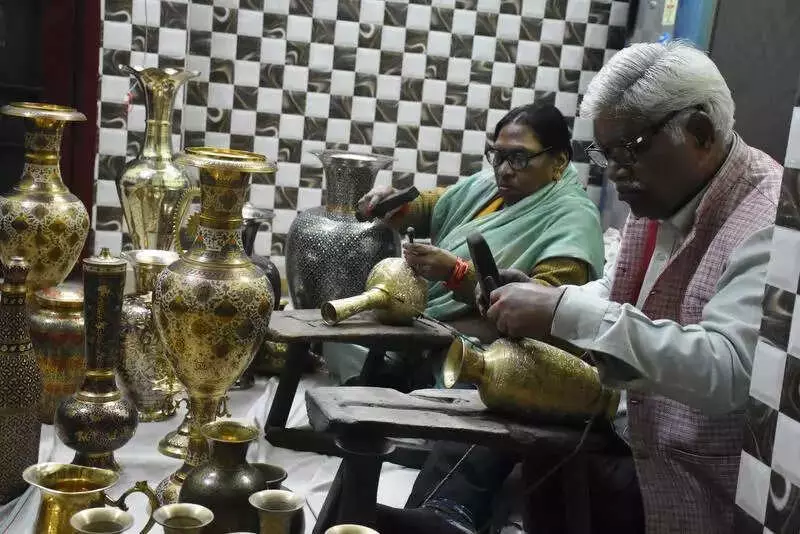
Yadav's journey began as a teenager in the crowded bylanes of Moradabad, where he apprenticed under the guidance of an old master, Amar Singh, whom his father knew. For three years, he immersed himself in learning the delicate techniques of naqqashi, mastering the art of transforming brass sheets into intricate ornamental pieces through meticulous hand-engraving.
In the early 1970s, he took up his first job, earning a modest Rs 60 per month. While this was sufficient initially, marriage brought new responsibilities, prompting Yadav to train his wife, Swanni Devi, in the same craft. "After marriage, he asked what I would do sitting at home," Swanni Devi recalled. "I worked with him for decades. I only stopped four years ago — my fingers hurt now."

Traditional Methods in a Modern Era
Over five decades, Yadav has steadfastly refused to abandon his traditional hand tools, even as machine-etched alternatives have flooded the market. Today, he works four to five hours daily, creating bespoke pieces that earn him between Rs 8 and 10 lakh annually through orders from government emporiums and private collectors.
Despite being illiterate, Yadav's legacy is supported by his son, Khub Singh Yadav, who registered their firm two decades ago and manages the business aspects. Khub Singh, also trained in naqqashi, acknowledges the challenges: "Machine-etched brass sells more because it's cheaper. Our work is slower, but each piece is different — there's a story in every one."
The Struggle to Preserve a Dying Art
Moradabad continues to export metalware in large quantities, but demand for detailed, hand-carved ornamental work like Yadav's has significantly declined. He remains one of the few artisans still training apprentices through the traditional guru-shishya model, emphasizing the personal transmission of skills that machines cannot replicate.
Yadav's accolades include the National Merit Award in 2008, multiple state honors, and the Shilp Guru title, one of India's highest recognitions for craftspeople. Yet, for him, the work transcends fame. "This is not just a job — it's our identity," he said softly. "I don't know how long it will last, but as long as my hands move, I'll keep doing it."
A Call for Greater Support
Khub Singh highlights the need for institutional support to sustain such traditional crafts. "The government needs to open up more platforms for us," he urged, pointing out that while their work commands a premium, broader accessibility could help revive interest among younger generations and ensure the survival of naqqashi as a living heritage.
As Yadav receives the Padma Shri, his story underscores a poignant reality: the survival of India's rich artisanal traditions hinges not only on individual perseverance but also on collective efforts to value and promote handcrafted excellence in an increasingly automated world.