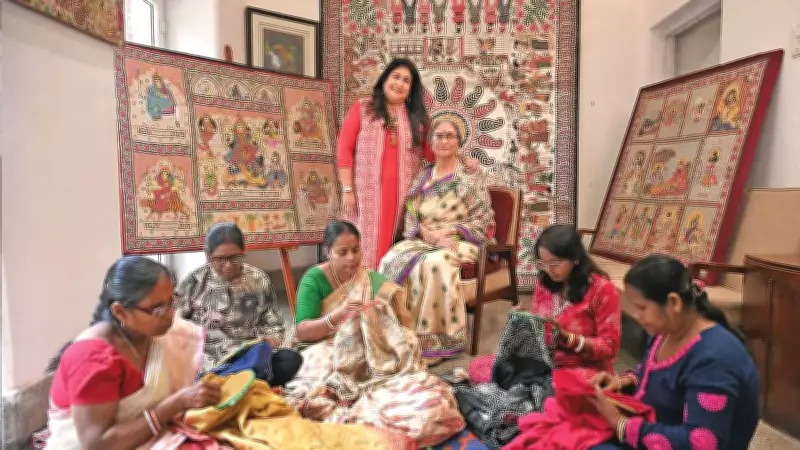
From Accidental Discovery to Global Movement: The 37-Year Kantha Revival
What began as a casual visit to a crafts mela with three silk saris has, over nearly four decades, transformed into a powerful movement that has reshaped the trajectory of Bengal's traditional running stitch embroidery. Kantha revivalist Shamlu Dudeja, now 87, is widely celebrated for taking this homegrown needlecraft from rural Bengal and placing it firmly in the international spotlight.
The Accidental Beginning That Changed Everything
"I didn't even know the word Kantha when I first saw it," recalls Shamlu Dudeja, reflecting on the moment that would define her life's work. While her daughter Mallika was playing tennis, Shamlu visited a Santiniketan crafts mela and encountered a simple embroidery that immediately transported her back to her school days, her Bengali craft teacher, and her mother.
Around that same period, her husband had brought back three silk saris from South India. In a moment of inspiration, Shamlu dyed these in tea and gave them to women at the mela to embroider, paying them in advance. When she and Mallika later visited these artisans' homes, they were simultaneously amazed by the intricacy of their craft and deeply moved by their challenging living conditions.

When the first three saris returned beautifully embroidered, Shamlu purchased more materials, repeated the process, and began sharing these unique pieces with friends and family across Kolkata, Mumbai, and London. The universal amazement she encountered revealed how few people outside Bengal knew about Kantha, sparking the curiosity that would fuel a decades-long revival.
Building SHE Kantha: From Three Women to Global Enterprise
What began without any formal plan has evolved into both a cultural revival and a significant financial empowerment initiative for women. SHE Kantha today empowers over 1,000 women artisans, with the organization growing from its initial three women to more than 1,200 artisans, many from remote villages across West Bengal.
Documented by Harvard Business School, the initiative focuses on four key pillars: income generation, agency, dignity preservation, and skill development. Shamlu traveled extensively, often using her personal savings, to introduce Kantha to audiences across India and internationally in France, Japan, the United States, and the United Kingdom.
The SHE Foundation now supports nearly 1,200 artisans who have been working with Kantha for over 35 years, while the associated Calcutta Foundation has expanded to more than 22 centers offering comprehensive training in stitching, digital skills, and livelihood development.
Three Generations Committed to Craft Preservation
Today, the movement continues through three generations of the Dudeja family. Shamlu's daughter Mallika Dudeja Varma and granddaughters Mahima and Saumya have joined the mission, bringing fresh perspectives while maintaining the core commitment to quality craftsmanship and fair wages.
"This was never meant to be CSR or structured social work," explains Mallika. "It began without a clear plan, evolving into both a revival of Kantha and financial empowerment for women."
Innovation Meets Tradition in Contemporary Applications
The organization is actively exploring new directions while preserving traditional techniques. SHE Art promotes Kantha as wall art through large, intricate works that often require years to complete. Simultaneously, the team is innovating in fashion by combining Kantha with aari and beadwork for contemporary and occasion wear, while introducing modern silhouettes like stoles and shirts.
"We are exploring geometric patterns for non-traditional markets in India and abroad while continuing to revive traditional Kantha," says Mallika. The organization is also experimenting with batik, hand-painted textiles, Kalamkari, and various fabrics including chiffon, georgette, and crepe.
Particular interest from younger audiences for items like Kantha jackets has encouraged expansion into more wearable formats. The team collaborates with young designers while ensuring that innovation remains closely linked to comprehensive training and sustainable growth.

Sustaining Quality in a Handcrafted World
The greatest challenge remains maintaining quality in a handcrafted process that cannot be mass-produced. "I'm happy Kantha has regained recognition through Maa's efforts," notes Mallika. "Maintaining quality remains a challenge, as fewer artisans commit to time-intensive work today."
Yet the impact is undeniable. Women artisans now support their children's education and make independent financial decisions, receiving payments directly with the flexibility to work at their own pace. SHE Kantha currently operates across 30 locations in West Bengal while serving clients globally.
A Life of Diverse Experiences That Shaped a Legacy
Shamlu Dudeja's journey to becoming a Kantha revivalist followed a varied path. She began her career teaching in schools before joining Loreto Teachers' Training College, where she trained young teachers in mathematics and authored several books that continue to earn royalties.
Born in Karachi, she witnessed historic moments around India's independence, including glimpses of Lord Mountbatten and Muhammad Ali Jinnah. After moving to India, her family settled in Delhi, where she grew up and studied before relocating to Mumbai, where she met her husband and eventually built her life in Kolkata.
Today, through her accidental discovery and persistent dedication, Shamlu Dudeja has not only revived a traditional craft but created sustainable livelihoods for thousands of women, proving that simple stitches can weave together cultural preservation, women's empowerment, and global recognition.