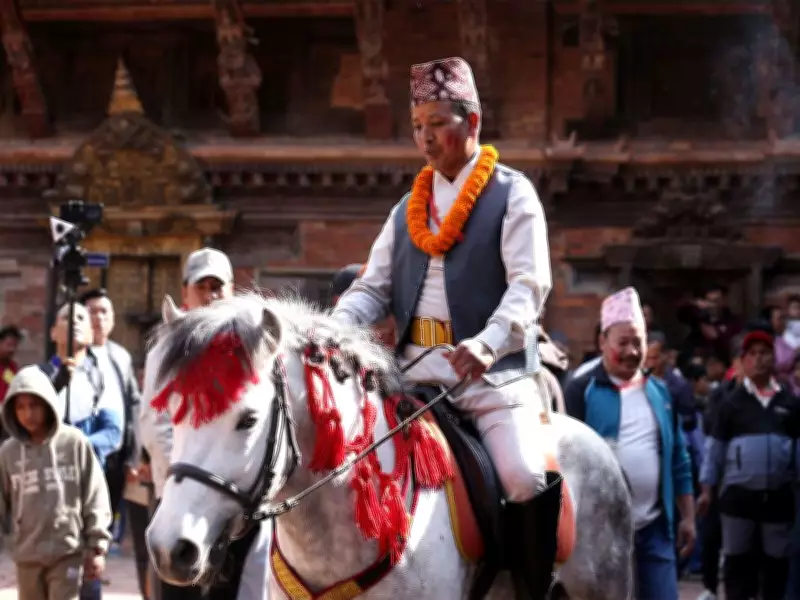
Kaji Saheb's Vermillion Procession Marks Nepal's Ghode Jatra Festival in Lalitpur
The ancient city of Lalitpur in Nepal was adorned with vibrant colors and cheers as the annual Ghode Jatra, or festival of horses, unfolded with a traditional procession led by the Kaji Saheb. Smeared in vermillion powder and draped in garlands, the Kaji Saheb, the highest post awarded in the royal palace, toured the historic streets, marking a centuries-old celebration that blends monarchy, mythology, and community spirit.
Ancient Traditions and Royal Origins
Speaking to ANI, Chandra Maharjan, a member of the Walkhu Chibaha: Guthi, which organizes the festival, explained its deep-rooted history. "It is a festival that has been in observance since the Malla regime," he said. During that era, a stable within the Patan Durbar Square premises belonged to the Malla royal families, with Maharjans serving as caretakers of the horses. According to legend, a Malla king once saw a caretaker resting with a 'Shesh Naag' (divine serpent) on his head, symbolizing divine kingship. Impressed, the king gifted his royal horse to the caretaker, initiating the tradition of the horse tour.
The Kaji Saheb, also known as "Ju-Ju" in the local Newa language, represents the monarchy. This annual procession was historically used to assess public conditions and governance. It is believed to have started during the reign of Sri Nivas Malla (1620-1661) in Patan. Earlier, Kathmandu had its own horse festival initiated by Pratap Malla (1624-1674) to monitor his subjects' welfare. Sri Nivas Malla later adopted the tradition in Patan to prevent locals from traveling to Kathmandu for the event.

Preservation and Modern Observance
Despite the passage of time, this festival from the Malla regime (13th to 18th Century) has been meticulously preserved by the Walkhu Chibaha: Guthi, run by the Maharjan community. Annually, members of the Guthi take turns riding the horse, covering about one kilometer through Lalitpur's ancient temples. Bystanders clap and cheer, congratulating the horse bearer, who is highly regarded in society.
The festivity, lasting barely an hour, concludes with the Kaji Saheb chewing betel, formally ending the procession for the year. "Taking out his procession is believed to bring good governance, win the trust of people, veer off bad spirits and evils, bring prosperity and relief, and keep people healthy," added Chandra Maharjan, noting that King Sri Nivas first introduced these beliefs.
Mythological Significance and Broader Celebrations
Ghode Jatra is observed on the new moon of Chaitra Sukla Paksha in the eastern lunar calendar, typically falling in mid-March or early April in the Gregorian calendar. It stems from a mythological belief celebrating the victory over a demon named Gurumapa (or Tundi), who terrorized the Kathmandu valley by kidnapping and devouring children. According to lore, horses trampled the demon to death, and he was buried under a tree in Kathmandu's Tundikhel ground. To prevent his spirit from returning, kings began the ritual of galloping over the field, evolving into the annual Ghode Jatra.
In Kathmandu, the Nepal Army holds a horse parade at the Tundikhel ground or Nepal Army Pavilion, attended by high-end dignitaries, showcasing the festival's national importance. Nepal has a special status for worshipping animals and birds, with Ghode Jatra highlighting the cultural reverence for horses.
This enduring tradition not only honors historical monarchies but also fosters community unity and spiritual beliefs, bridging ancient practices with contemporary celebrations in Nepal's rich cultural tapestry.