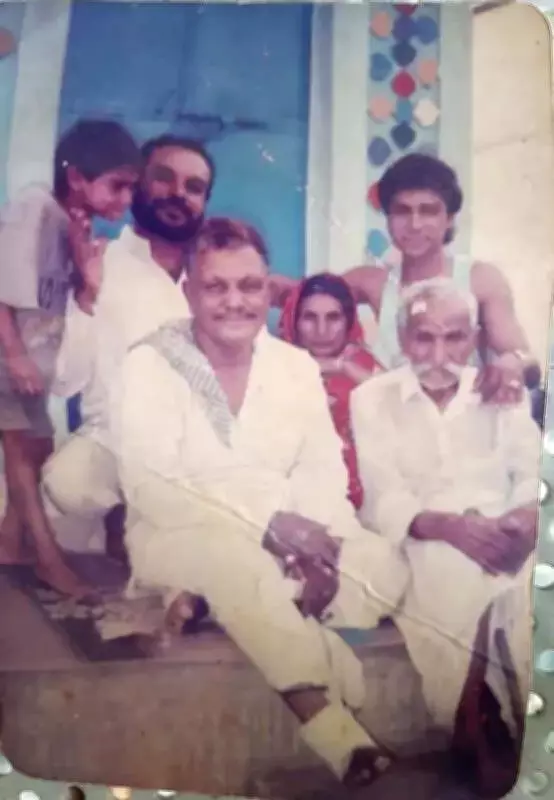
Bhopal has a subtle way of tucking away its open secrets, like Farsi-speaking citizens, within its folds and hamlets, almost forgetting about them or just letting them be in their own quiet corners. In Karond, after passing a labyrinth of bylanes, one might reach one of Bhopal's three Irani Deras, if the city allows it. Citizens here have had to carry their homes in bundles on multiple occasions.
In the past decade or so, this locality has seen and endured everything from muffled shouts of sectarian attacks and arson to whispers of criminal syndicates amplified when they hit news reels and headlines. But on any given day, if you land here, you might see an old woman scolding her grandkids and their friends in Farsi, a language that is all but fading from this part of the world. Aman Colony is home to Shia families, minorities within the minority Muslims in India, whose ancestors had roots in Iran but chose to live in their adopted homeland. As Iran hogs global headlines for the ongoing tenuous truce and the devastating war with the U.S. and Israel, these quiet deras carry a slice of Persian civilisation that predates Western civilisation by 150 to 300 years, according to some estimates.
Khanabadosh: Nomads Who Settled at Railway Stations
'Khanabadosh' is an Urdu-Persian term that became part of the Hindustani language, much like the Indian-Iranian community itself. The word roughly translates to 'those who carry their homes on their shoulders.' Members of the community said that sometime around 1875, Bhopal's Irani Dera, known as the Sulta Muraad community, pitched a permanent camp in Sehore, where graves of their ancestors still lie. Around 1960, the community moved to Bhopal and settled near the old railway station. 'Nomadic communities, coupled with other Indian-Iranian people, started living near railway stations as it was easy to pitch makeshift tents there,' said Ghulam Haider, also known as Ghulam Irani. A Bhopal resident who runs a travel agency, Ghulam's grandfather was the chief or Sardaar of the Sulta Muraad Irani Dera, named after the 7th generation ancestor who lived in Shiraz, Iran.

People in some Irani Deras, like Gulaabwara, say their ancestors came to India 400 to 500 years ago. 'We have been living in India across six generations. My great-great-great grandfather, Azeez Khan, came to India by land to sell the finest breeds of horses around the 1870s. Back then, there was great demand among Maharajas and Nawabs for Iranian horses, shawls, carpets, and other items,' Ghulam told TOI, reminiscing about his family history. Down the line, his ancestors sold goggles and glasses on the streets, which Ghulam said many Indian-Iranians still do in New Market, where they also deal in gemstones. His grandfather, Munawwar Ali, worked in carnivals with giant wheels and 'jhulays' (merry-go-rounds) at fairs. Munawwar's son, Aslam Ali, started a travel agency around 1986-87, which Ghulam continues to run.
Assimilation, Food, and Marriages
Around the world, assimilation, holding onto distinct identities, and immigration are raging debates. But in Bhopal, these complex issues only seem to live on in the hearts of those who experience them. 'I would say the Persian community has Indianised itself by 50%, while its other half is still tethered to its original roots,' Ghulam said. 'For instance, our marriages now include the Haldi ceremony, but as per our customs, dowry is not taken but given to the girl and her family.' While they have ingrained many Indian customs, it hasn't been at the cost of their rich culinary identity: they still burn their kitchen fires to rustle up 'Paagushti', a sumptuous dish made with meat, red and green chillies, and Kalpaaya. The women in the community used to wear ghagras in the 20th century but now are more inclined towards Punjabi dresses.
The Bollywood Connection
Ali Raza, a member of Bhopal's Indian-Iranian community who now works at a mosque in Maharashtra, shared: 'Indians are treated extremely well in Iran because we have a civilisational connect, and Iranians are huge fans of Amitabh Bachchan and Shah Rukh Khan. Their movies are dubbed in Farsi and screened in theatres after removing the songs and dances. We love Bollywood films and actors.'

Reconnecting With Roots
Ghulam has visited the land of his forefathers four times. A few years ago, an Iranian delegation visited the Irani Deras on a trip to Bhopal. The delegates were astonished to see original dialects of Farsi, traditions, and ways preserved in Bhopal. They found little things that tie them to their civilisational roots far more easily in this Indian city than back home.
Lack of Education, Awareness, and Opportunities
A resident of Karond's Irani Dera, requesting anonymity, said that because a handful of members are alleged to have fallen foul of the law, some people stereotype and discriminate against the entire community, looking on them as 'criminals.' 'Our community in Bhopal has 2,000 members. Sadly, all of them are seen as criminals, which I feel is highly unfair.' 'Lack of education is the biggest issue our community faces. There's internal reluctance due to financial constraints. Lack of awareness and opportunities is also to blame. The problem is especially grave among our girls, as very few get to complete their education or become graduates,' stressed Ghulam. He said two boys he knows personally are still studying in Iran, adding that his son, now an MBA, helps with his business. Ghulam said his daughter is the only girl to have graduated in his neighborhood.
For decades, the only connection between Irani Deras around India—also in Madras, Maharashtra, and other parts—was Muharram, a mourning month for Shia Muslims when all members wear black and take out processions remembering the martyrdom of Imam Hussain. However, the emergence of new modes of communication and travel has not only boosted people-to-people connect within the community but also helped them retrace their roots through books and old scriptures while passing on their knowledge to their children.