Indian Museum Unveils Historic Water Heritage Exhibition for 212th Foundation Day
In a landmark event for cultural preservation, Kolkata's prestigious Indian Museum has launched its first-ever exhibition drawn entirely from its reserve collection to celebrate the institution's 212th foundation day on February 2. The groundbreaking display, titled "Beyond the Land: Markers of India's Riverine and Maritime Heritage," offers a profound exploration of how water bodies have fundamentally shaped the subcontinent's civilisational journey.
Tracing Civilisational Connections Through Waterways
The exhibition presents a compelling narrative that positions India's rivers, coastlines, and seas as vital corridors of communication long before political boundaries or written records emerged. These waterways served as dynamic channels carrying people, ideas, beliefs, and technologies across regions and continents, creating networks that defined cultural, economic, and spiritual development.
"Antiquities illuminate river-based networks of the Harappan civilisation and far-reaching maritime connections linking India with Africa, West Asia, the Mediterranean, and Southeast Asia," explained IM director Sayan Bhattacharya. "Through artefacts, inscriptions, and visual narratives, we highlight themes of commerce, craftsmanship, mobility, and cultural continuity, underscoring how water routes played a defining role in shaping Indian history."

Sacred Waters and Mythological Connections
One particularly fascinating section, "Across the Sacred Waters," delves into India's oceanic imagination through the Ramayana, where the legendary bridge to Lanka symbolizes the convergence of myth, devotion, maritime knowledge, and engineering skill. This perspective reveals how ancient civilizations viewed oceans not as barriers but as living connectors between lands and peoples.
The exhibition gives special prominence to the sacred rivers Ganga and Yamuna, presenting them as enduring lifelines of Indian civilisation that nurtured early urban centres, agricultural abundance, and trade networks while remaining central to belief systems, ritual life, and cultural memory. A dedicated focus on Varanasi showcases how this ancient city flourished for millennia as a spiritual, cultural, and economic hub along the Ganga, seamlessly connecting inland centres to wider maritime worlds.
Ancient Trade Networks and Cultural Exchange
Visitors can explore the Harappan civilisation's sophisticated river-oriented urban networks through evidence of advanced dockyards, standardized weights, seals, and craft production that enabled long-distance trade with West Asia and the Persian Gulf. The exhibition traces how rivers and seas facilitated the spread of Buddhism during the Mauryan period under Emperor Asoka, carrying the Buddha's teachings across South Asia, Sri Lanka, and Southeast Asia.
Global connections form a crucial narrative thread, with displays illustrating India's central role in ancient trade networks linking Mesopotamia, Egypt, Persia, Greece, and Rome. The exhibition highlights how knowledge of monsoon winds enabled regular maritime exchange of spices, textiles, beads, and precious goods through ports along India's coasts and the Ganga delta.
Southeast Asian Connections and Spiritual Influence
The final sections examine the "Silk Road of the Sea," where Indian mariners, traders, monks, and artisans carried religion, art, political ideas, and technologies across the Bay of Bengal. Inscriptions such as the Bodhgaya inscription of Mahanaman, carved in Siddhamatrika script, stand as enduring testimony to India's cultural and spiritual influence beyond its borders.
Key Artefacts and Historical Significance
The exhibition features remarkable artefacts that collectively reveal how rivers and seas functioned as arteries of commerce, faith, and cultural exchange:

- Harappan seals and standardized weights reflecting early systems of trade, administration, and long-distance exchange
- Terracotta vessels, beads, and craft objects linked to river-based urban centres of the Indus civilisation
- Maritime trade artefacts demonstrating contact with West Asia, the Persian Gulf, Greece, and Rome
- Inscriptions and stone records tracing religious, cultural, and political connections across regions
- Buddhist sculptures and inscribed stones documenting the spread of Buddhism through river and sea routes
- The Bodhgaya inscription of Mahanaman highlighting India's spiritual influence in Sri Lanka and Southeast Asia
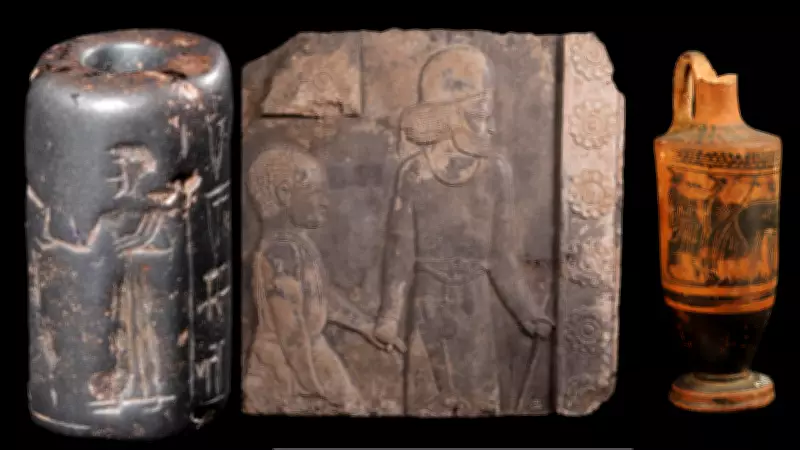
Notable displayed items include the Vajra (Royal Boat) from 12th-13th century CE Odisha made of steatite, a Lekythos terracotta vessel from 1st century CE India, and various Harappan period artefacts that collectively position India as a key participant in the ancient interconnected world.
As the Indian Museum enters its 212th year, "Beyond the Land" powerfully positions water as both witness and agent of history, revealing India as an active and influential presence in ancient global networks. The exhibition reaffirms the museum's role as a custodian of the subcontinent's shared heritage and a vital bridge between past and present, aligning with national visions of cultural preservation and unity.