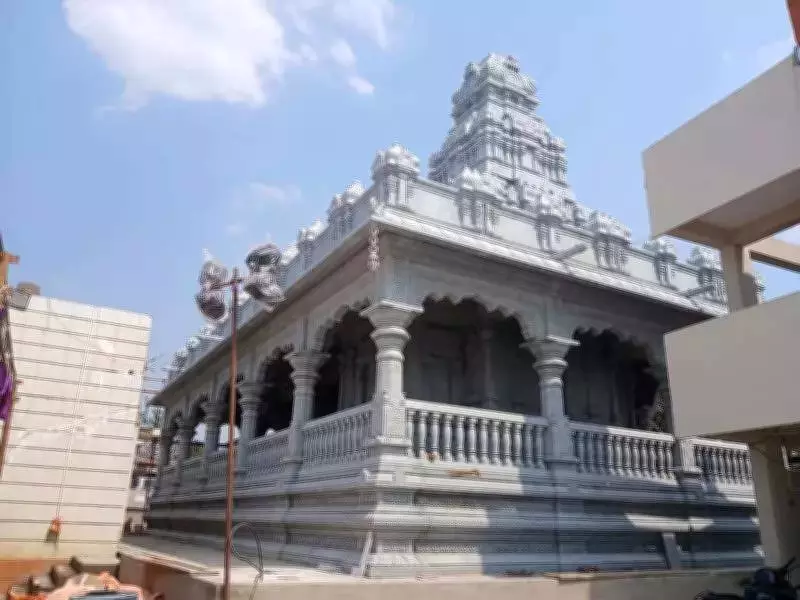
Hubballi Unveils Innovative Rs 3 Crore Temple Built Without Traditional Materials
Hubballi, already renowned for the historic Chandramouleshwara temple and scenic Unkal lake, has added a remarkable new attraction to its landscape. The newly constructed Siddappajja temple, inaugurated on Monday evening by Prasanna Renuka Veera Someshwara Shivacharya of Rambhapuri Peetha, stands as a testament to innovative architectural techniques. Located strategically on the Hubballi–Dharwad road, this temple is built entirely without the use of cement, sand, bricks, or even string, relying instead on an intricate interlocking stone system.
Architectural Marvel with 'Infinite Life' Design
Committee members proudly assert that the structure boasts an 'infinite life', barring catastrophic natural events like earthquakes. Positioned on the bank of Unkal lake, the temple was meticulously designed to offer unobstructed views of the water and open skies from its premises. The project, executed in the classic Dravidian style, incurred a total cost of approximately Rs 3 crore, funded largely through community efforts and donations.
Community-Driven Initiative and Historical Context
Rajanna Koravi, chairman of the Sadguru Sri Siddeshwar Swami Math (Hosa Math) Pancha Committee, explained that the existing temple had lost its charm following the construction of the BRTS corridor. "When renovation discussions began, devotees expressed a desire for a unique temple," he stated. The project was launched on a crowd-funding basis two years ago, leveraging a 2-acre plot donated a century ago by Neelamma and Sannafakkirappa Benachi. "Within just 10 minutes, we mobilized Rs 42 lakh in donations, and this overwhelming solidarity energized our team. Dharmasthala Dharmadhikari Veerendra Heggade further motivated us with a generous contribution of Rs 5 lakh," Koravi added.

Blending Architectural Styles and Spiritual Heritage
Vishwanath Koravi, a temple committee member, highlighted the spiritual significance, noting that Siddharoodha and Siddappajja lived in the same era, with Siddharoodha known as 'Rajayogi' and Siddappajja as 'Hathayogi'. Architecturally, the temple incorporates Dravidian style with subtle influences from Chalukya, Kadamba, and Hoysala traditions, creating a harmonious blend of historical elements.
Detailed Construction and Artistic Features
Chief sculptor Jayanth Jattayoa Naik from Murudeshwar detailed the temple's features:
- An 8-foot granite block forms the robust foundation.
- The Gopura rises 27 feet high in pure Dravidian style.
- The sanctum sanctorum houses a statue of Siddappajja, while a 6-foot Nandi statue graces the Rajyangana.
- Two elephant idols are installed at the entrance, enhancing the grandeur.
Naik emphasized that the lake view is accessible from the temple's backside, a design choice that enhances the spiritual ambiance.
Innovative Engineering and Aesthetic Lighting
Architect Guru Hiremath elaborated on the construction methodology, revealing that only Bagepalli stone was used from foundation to Gopura. "We completely avoided cement, string, and sand, connecting stones through an advanced interlocking system," he explained. The temple measures 35 feet in width and 61 feet in length at plinth level. Hiremath further described the aesthetic enhancements:
- Dravidian-style carvings are accentuated by lighting effects in the ceiling and columns.
- The design merges traditional Dravidian elements with a contemporary look.
- Electrical work embedded in the flooring illuminates the columns, creating a warm, calm, and peaceful atmosphere for devotees.
Hiremath expressed confidence that the temple will gain tourism significance, potentially rivaling heritage sites like Hampi and Badami, thanks to its unique construction and spiritual appeal.