The Enduring Legacy of George Orwell's Dystopian Visions
It remains profoundly difficult to forget the harsh, oppressive world where Big Brother maintains constant surveillance over every citizen. A reality where objective truth becomes twisted beyond recognition, where personal memory is systematically controlled, and where language itself transforms into a weapon of manipulation represents not just fictional speculation but a chilling possibility that continues to haunt modern consciousness. George Orwell's imagined dystopian worlds persist in cultural memory precisely because they echo unsettling similarities with contemporary society. His powerful warnings continue to resonate deeply within readers' minds long after they complete his books, serving as persistent reminders that individual freedom remains fragile and requires vigilant, continuous defense against encroaching authoritarianism.
The Formative Experiences That Shaped Orwell's Worldview
Eric Arthur Blair, born in 1903 in British India during colonial rule, adopted the pen name George Orwell as he embarked on his literary career. Growing up in England and attending the prestigious Eton College exposed him early to stark class divisions and systemic social inequality—themes that would fundamentally shape his future writing. Orwell deliberately rejected the sheltered existence of a detached intellectual, instead immersing himself directly among society's poor and marginalized communities. His diverse experiences working as a dishwasher, schoolteacher, and police officer in Burma provided firsthand exposure to institutional injustice and unchecked authority, cultivating a lifelong skepticism toward concentrated power structures.
Political Awakening and Literary Philosophy
Orwell's political consciousness underwent significant transformation during his participation in the Spanish Civil War, where he witnessed propaganda machinery, political betrayals, and systematic distortion of facts across ideological factions. This disillusionment with totalitarian systems solidified his commitment to writing characterized by clarity, intellectual honesty, and moral engagement. Orwell firmly believed that effective writing required simplicity over ornamentation—that clear language formed the essential foundation for clear thinking and ethical communication.

Masterworks of Political Allegory: Animal Farm and 1984
Animal Farm, published in 1945, employs deceptively simple animal characters overthrowing their human owner to illustrate how revolutionary ideals inevitably corrupt when power consolidates. What begins as an inspiring vision of equality gradually deteriorates into brutal tyranny, demonstrating how even the noblest intentions become vulnerable to power's corrupting influence. Beneath its accessible narrative surface, the novel delivers penetrating criticism of authoritarian control mechanisms and psychological manipulation techniques.
The Chilling Prophecy of Nineteen Eighty-Four
Orwell's darkest and most enduring creation, Nineteen Eighty-Four (published in 1949), presents readers with a terrifying future where an omnipotent Party exercises total control over reality itself. The novel depicts a society characterized by perpetual surveillance, rewritten history, and systematic mind control—concepts that have entered everyday vocabulary through terms like "Big Brother," "Newspeak," and "Thought Police." Orwell intended this work not as literal prediction but as urgent warning, a caution that feels increasingly pertinent amid contemporary digital surveillance ecosystems and widespread misinformation campaigns.
The Power of Historical Manipulation
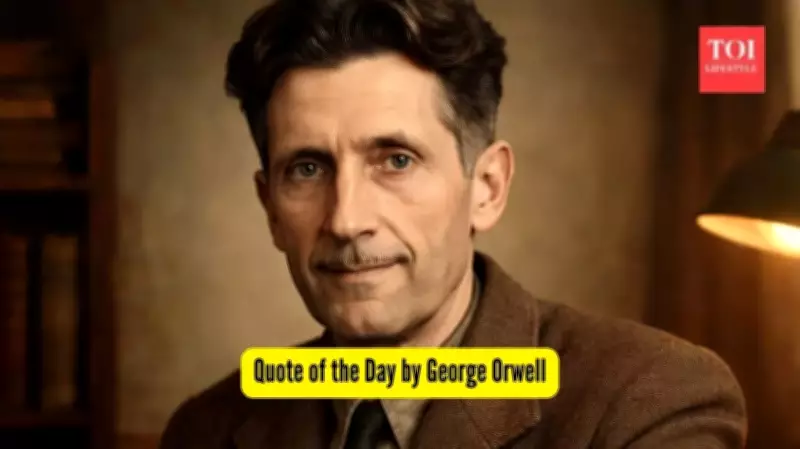
One of George Orwell's most frequently quoted observations states: "The most effective way to destroy people is to deny and obliterate their own understanding of their history." This powerful statement encapsulates the central anxiety permeating Orwell's body of work—that controlling historical narrative represents the ultimate form of power. In Nineteen Eighty-Four, the Party continuously alters historical records to eliminate objective truth, creating conditions where citizens cannot challenge authority when they cannot trust their memories or documentation.

Psychological Consequences of Historical Erasure
This manipulation extends beyond political control to psychological disintegration. Personal and collective history constitutes fundamental identity—our sense of self emerges from individual memories, shared struggles, and communal narratives. When these foundations become erased or distorted, individuals experience profound disorientation and psychological dependency. Orwell recognized that censorship operates not exclusively through overt violence but often through bureaucratic, systematic processes that escape immediate detection.
Historical truth becomes diluted into meaninglessness through multiple mechanisms:
- Gradual textbook revisions that shift historical perspectives
- Systematic control over media narratives and public discourse
- Information overload creating contradictory versions of events
- Subtle language modifications that reshape collective memory
Orwell understood that historical destruction rarely resembles dramatic book-burning ceremonies—more frequently, it manifests as quiet, incremental rewriting that escapes public notice until the original truth becomes irrecoverable.
Contemporary Relevance in the Digital Age
Orwell's insights gain renewed significance as modern societies navigate complex challenges including mass digital surveillance, algorithmic manipulation of information, and sophisticated propaganda networks. The conceptual frameworks he developed—surveillance capitalism, historical revisionism, linguistic manipulation—provide valuable lenses for analyzing contemporary power structures and defending democratic values against emerging authoritarian tendencies.
His works continue to inspire critical examination of how technology, media, and political institutions might potentially undermine individual autonomy and collective truth. As readers revisit Animal Farm and Nineteen Eighty-Four, they discover not merely historical artifacts but living texts that illuminate ongoing struggles for transparency, accountability, and intellectual freedom in increasingly complex information environments.