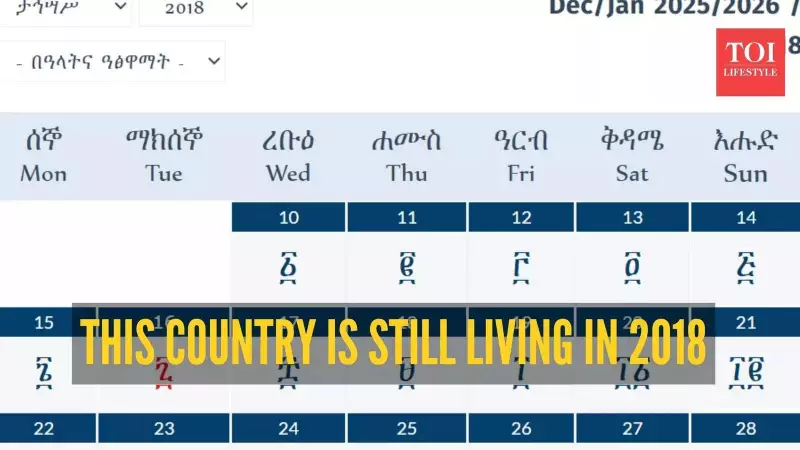
As the world raised glasses to welcome the year 2026 on January 1st, one nation stood apart, not in protest, but in adherence to its own ancient rhythm of time. Ethiopia, the East African country, officially marked a different year: 2018. This is not an error or an internet meme, but a living tradition rooted in a unique calendar system that has governed Ethiopian life for centuries.
The Ethiopian Calendar: A System Unlike Any Other
While most of the planet operates on the Gregorian calendar, Ethiopia officially follows the Geʽez, also known as the Ethiopian calendar. This is a traditional solar calendar with its own distinct calculations. The most striking result is that Ethiopia runs approximately seven to eight years "behind" the globally accepted date. Furthermore, their New Year does not begin in January. Ethiopians actually stepped into their year 2018 in September of 2025, meaning they were months into their 2018 when the rest of the world celebrated 2026.
Thirteen Months and Ancient Roots
The structure of the Ethiopian calendar is one of its most captivating features. Instead of 12 months of varying lengths, it comprises 13 months. Twelve of these months have exactly 30 days each. The 13th month, called Pagume, is a short period of five days (extending to six during a leap year). This system is not merely for cultural festivals; it is deeply integrated into the nation's fabric. The Geʽez calendar is used in all official capacities—in courts, banks, schools, government offices, and daily documentation, serving as the primary timeline for Ethiopians.

The calendar's origins trace back to the ancient Coptic calendar of Egypt and has seen little change over hundreds of years. The significant year gap stems from an ancient theological calculation. When the Gregorian calendar was refined in 1582, it was based on the work of Dionysius Exiguus, who set the birth of Jesus Christ as "Year 1." However, the Ethiopian and older Alexandrian traditions followed different calculations, placing Christ's birth several years later. This foundational difference created the persistent seven-to-eight-year divergence we see today.
Living on a Different Timeline
The Ethiopian year begins in Meskerem (September) and flows through months with poetic names: Tikimt, Hidar, Tahsas, Tir, Yekatit, Megabit, Miazia, Ginbot, Sene, Hamle, and Nehase. The cycle concludes with Pagume in early September, just before the new year begins again. This enduring practice is a powerful reminder of cultural sovereignty and diversity.
Ethiopia is not lost in time or resisting modernity. It is confidently living by a continuous, generations-old calendar system. In a globalized world often synchronized to a single clock, Ethiopia's timeline stands as a testament to the rich tapestry of human civilization, proving that not every country needs to tick to the same second.