A Kolkata-based research group has launched a significant campaign to honour a group of often-overlooked freedom fighters. The Ullaskar Dutta Academy has formally demanded that twelve cells within the historic Cellular Jail in Port Blair be named after the first batch of political prisoners from Bengal, who were incarcerated there over a century ago.
The Historic Demand for Recognition
The academy has written letters to Prime Minister Narendra Modi's office, West Bengal Chief Minister Mamata Banerjee, and the administration of the Andaman and Nicobar Islands. Their core demand is to dedicate cells to twelve revolutionaries convicted in the famous Alipore Bomb Conspiracy Case of 1908. This case led to the hanging of young martyrs like Khudiram Bose, Kanailal Dutta, and Satyendranath Bose.
Currently, only two cells at the Cellular Jail are dedicated to former inmates: Vinayak Damodar Savarkar and Sachindra Nath Sanyal. The group argues that the contribution of the Bengal revolutionaries, who were among the very first to be sent to the dreaded Kalapani (Cellular Jail), deserves equal memorialisation.

The Forgotten Heroes of the Alipore Bomb Case
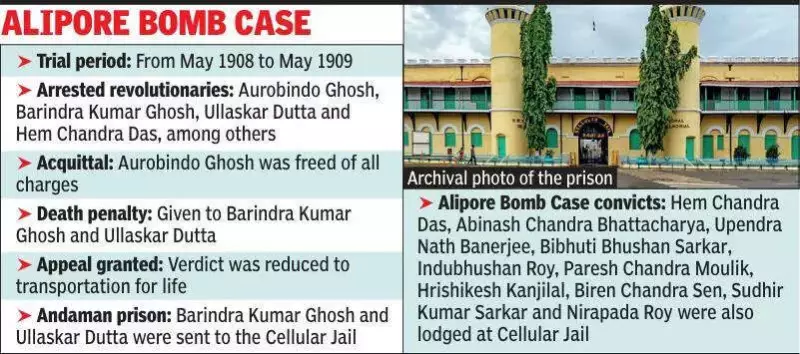
The story traces back to 1908 when the British government arrested a large group of nationalist revolutionaries. Prominent among them were leader Aurobindo Ghosh, his brother Barindra Kumar Ghosh, and Ullaskar Dutta, after whom the academy is named. Others included Hem Chandra Das, Upendra Nath Banerjee, and Indubhushan Roy.
After a year-long trial, Aurobindo Ghosh was acquitted. However, Barindra Kumar Ghosh, as the head of the secret society, and Ullaskar Dutta, as the bomb-maker, were initially sentenced to death. On appeal, their punishment was reduced to transportation for life, leading to their imprisonment in the Cellular Jail.
They were not alone. A larger group sentenced to life or long-term rigorous imprisonment was also deported. This group included:
- Hem Chandra Das
- Abinash Chandra Bhattacharya
- Upendra Nath Banerjee
- Bibhuti Bhushan Sarkar
- Indubhushan Roy
- Paresh Chandra Moulik
- Hrishikesh Kanjilal
- Biren Chandra Sen
- Sudhir Kumar Sarkar
- Nirapada Roy
Subhra Gupta, managing trustee of the Ullaskar Dutta Academy, emphasised their suffering. "These 12 political prisoners were the first large group convicted for politically motivated crimes. They endured rigorous imprisonment and cruelty in Kalapani. In isolated cells, they faced gruelling chores and the harshest torture for disobedience," he stated.
Reassessing History and Preserving Memory
Gupta lamented that the contributions of these revolutionaries have been largely wiped from popular historical narratives. "They are an integral part of India's freedom struggle. Just as separate cells are dedicated in the name of Savarkar and Sanyal, it is time we recognise the struggle of these 12 revolutionaries and preserve their memories," he urged.
Echoing this sentiment, the academy's advisor, Prasanta Paul, said, "It is time we reassess the history of the freedom movement by focusing on Bengali revolutionaries." This call for a broader historical perspective is supported by data. The Ministry of Culture and Tourism, in a response to Trinamool MP Ritabrata Banerjee, revealed that 585 revolutionaries were jailed in the Cellular Jail from 1909 to 1938. Out of these, a staggering 398 were from undivided Bengal, underscoring the region's pivotal role in the armed resistance against British rule.
The campaign by the Ullaskar Dutta Academy is more than a request for signage; it is a push for a more inclusive and accurate remembrance of the sacrifices that shaped modern India.