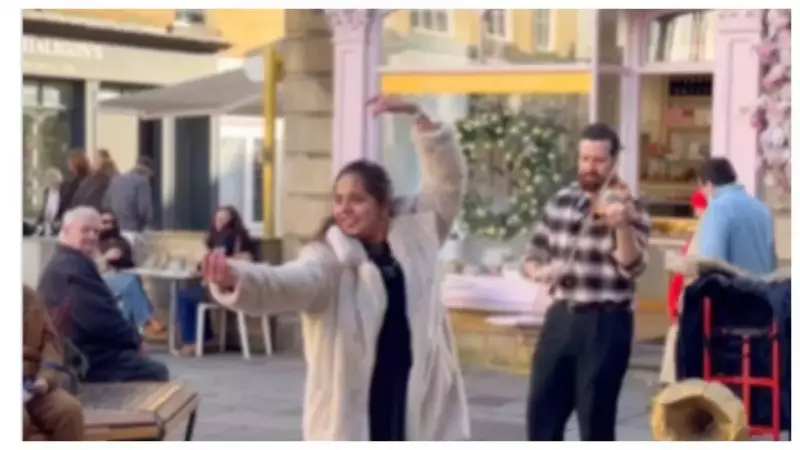
A heartwarming video showcasing a spontaneous fusion of Indian classical dance and Western music on a London street has taken the internet by storm, evoking pride and admiration from viewers worldwide.
Viral Street Performance Unites Cultures
The clip features an Indian woman performing the ancient dance form of Bharatanatyam on Bath Street in London. The scene becomes even more enchanting as a violinist, originally playing the piano nearby, seamlessly joins her performance with his music. The woman, dressed in an indo-western black outfit and a coat, concluded her dance with a graceful Namaste, receiving applause from gathered onlookers.
Sharing the magical moment online, the dancer expressed her feelings, writing about how the violinist played along and how the moving streets of Bath made her feel free, allowing her soul to dance.

Internet Reacts with Love and Pride
The video quickly garnered widespread affection. One user mistakenly praised it as Kuchipudi, another classical Indian dance form, to which the dancer politely clarified it was Bharatanatyam. This led to a brief, friendly discussion about the similarities between the two styles. The overwhelming sentiment, however, was one of pure appreciation.
Comments flooded in celebrating the unique collaboration. Users called it "the type of collab we want to see on the internet" and praised the beautiful infusion of "western music with classical dance." The performance was hailed as a powerful, cross-cultural connection that resonated deeply with a global audience.
The Sacred History of Bharatanatyam
This viral moment connects to a rich, millennia-old tradition. Bharatanatyam is a classical Indian dance that originated over 2000 years ago in the temple spaces of Tamil Nadu. It is renowned for its elegant techniques, intricate footwork, hand gestures (mudras), and facial expressions used to narrate complex stories and convey emotions.
Its theoretical foundations are laid out in the Natya Shastra, a seminal Sanskrit text on performing arts composed by sage Bharata Muni between 200 BCE and 200 CE. Legend states Lord Brahma created this art by combining elements from the four Vedas.
From the 4th to the 12th centuries, the dance was performed as Sadir Attam or Dasi Attam by devadasis (temple servants) in South Indian temples under the patronage of Chola and Pallava rulers. They performed sacred dances dedicated to Lord Shiva as Nataraja, the cosmic dancer. Temple carvings in places like Kanchipuram from the 6th to 9th centuries depict these dance postures, showcasing the art's sophistication during that era.
Revival of a Classical Art Form
After flourishing in royal courts, Bharatanatyam faced a decline during the 19th century under British colonial rule. Its modern revival is a significant chapter in India's cultural history. Pioneers resurrected the dance in the 20th century, aligning it with the Indian freedom movement. A key figure, E. Krishna Iyer, officially gave the dance its current name, Bharatanatyam, in 1932, re-establishing its link to the ancient Natya Shastra and shedding colonial-era stigma.
The London street performance is a vibrant testament to this revival, demonstrating how a sacred, classical art form can transcend geographical and cultural boundaries, creating moments of universal beauty and shared human experience in the modern world.