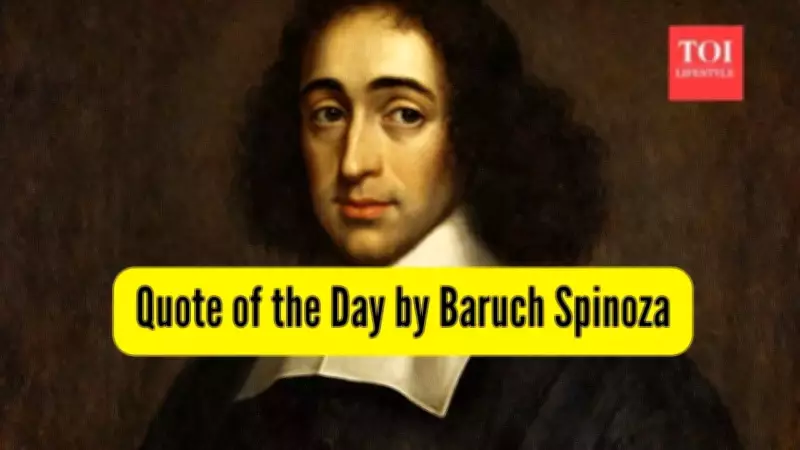
Baruch Spinoza: The Radical Philosopher Who Redefined God and Freedom
Baruch Spinoza, originally named Bento de Spinoza, was born in 1632 in Amsterdam and stands as one of the most revolutionary philosophers in Western history. A Dutch thinker of Portuguese-Jewish heritage, he boldly challenged religious dogmas, political authorities, and anthropocentric perspectives of the universe. His life was marked by intellectual rebellion, leading to his excommunication from his own community, yet he maintained a quiet existence that profoundly impacted Enlightenment giants such as John Locke, Voltaire, and even Albert Einstein. Spinoza's philosophy, grounded in rationalism, pantheism, and an unwavering commitment to truth, remains strikingly modern, advocating for harmony with the universe's immutable order rather than resistance.
Early Life and Exile from Faith
Spinoza entered the world on November 24, 1632, into a flourishing Sephardic Jewish community in Amsterdam, composed of refugees fleeing the Portuguese Inquisition. His father, Michael, was a prosperous spice merchant who ensured young Bento received an education at the Talmud Torah school, where he mastered Hebrew, the Torah, and rabbinic literature. Tragedy struck early: his mother, Hanna Deborah, passed away when he was six, followed by the deaths of three siblings, leaving him as the sole surviving son. By his late teens, Spinoza had expanded his studies to include Latin, Cartesian philosophy, and radical texts through the Collegiant movement, a liberal Christian group emphasizing free inquiry. This exposure fueled his growing skepticism toward orthodox Judaism, leading him to question miracles, the soul's immortality, and anthropomorphic depictions of God, drawing on influences from medieval thinkers like Maimonides and contemporary scientists like Descartes.
At age 23, the Amsterdam synagogue issued a severe cherem (ban) against him, condemning him with curses from the Law. Accused of threatening immortality and promoting abominable heresies, Spinoza's true offense was his rational skepticism within a vulnerable community. Cast out, he adopted the Latinized name Baruch, meaning blessed, and the anglicized Benedictus, becoming Benedictus de Spinoza. To sustain himself, he took up lens grinding for telescopes and microscopes, work that honed his precision but tragically contributed to his death from lung disease caused by glass dust at age 44. Spinoza never married, choosing a simple life among friends and rejecting academic positions to preserve his independence.

Major Works and Intellectual Battles
Spinoza's writings were often clandestine due to fears among booksellers of repercussions for distributing banned material. His breakthrough came with the anonymously published Theological-Political Treatise in 1670, which argued that the Bible should be interpreted as human literature rather than divine dictation, championing freedom of thought against clerical tyranny. The work sparked scandal and was labeled atheistic, despite Spinoza's theistic leanings. His magnum opus, Ethics, was published posthumously in 1677, structured like Euclid's proofs with axioms and propositions to explore God, mind, emotions, and virtue. Earlier works such as Short Treatise on God, Man, and His Well-Being (circa 1660) and Principles of Cartesian Philosophy (1663) helped refine his philosophical system. Spinoza engaged with students, corresponded with figures like Leibniz and Henry Oldenburg of the Royal Society, and even drafted a Hebrew republic constitution for revolutionaries, ideas that continue to resonate in modern democratic frameworks.
He succumbed to tuberculosis (phthisis) in The Hague on February 21, 1677, with a well-attended funeral. His friends ensured the publication of Ethics and Political Treatise, securing his enduring legacy.

Core Philosophical Concepts: Substance, God, and Conatus
At the heart of Spinoza's metaphysics lies the concept of substance, defined as reality existing independently. Ethics Part I, Proposition 1 states: Substance is by its nature prior to its modifications. He posited a monistic view where there is only one substance: God or Nature (Deus sive Natura), infinite and eternal. This contrasts sharply with Descartes' dualism, as Spinoza asserted that everything—planets, thoughts, emotions—are modes or attributes of this singular substance. His philosophy is often described as pantheistic, rejecting creation ex nihilo and envisioning God not as a personal ruler but as the immanent cause of all existence. Human knowledge, according to Spinoza, progresses through three stages: imagination (error-prone and sensory-based), reason (grounded in common notions), and intuition (grasping eternal truths). He dismissed free will as an illusion, emphasizing that we are governed by necessity, with ignorance leading to servitude.
Central to his ethics is the idea of conatus: every entity strives to persist in its being (Ethics IIIP6). This drive influences emotions, where joy enhances power and sadness diminishes it. Spinoza advocated for the intellectual love of God, urging individuals to comprehend necessity, temper passions through reason, and achieve amor Dei intellectualis. Virtue, in his view, equates to power, and blessedness arises from intuitive unity with Nature. He championed a tolerant democracy guided by reason without coercion, principles that underpin foundational documents like the First Amendment to the U.S. Constitution. Spinoza's radicalism rejected miracles, intercessory prayer, and afterlife rewards, instead offering liberation through knowledge. Albert Einstein famously aligned with him, stating, I believe in Spinoza's God, who manifests himself in the lawful harmony of the universe.
Analyzing a Key Quote: Embracing Reality
Consider the quote: The more you struggle to live, the less you live. Give up the notion that you must be sure of what you are doing. Instead, surrender to what is real within you, for that alone is sure....you are above everything distressing. This encapsulates Spinoza's philosophy: excessive control and certainty-seeking diminish life's vitality, inducing stress. He suggests relinquishing the need for absolute assurance and trusting one's deeper instincts and values. Surrendering to what is real within means aligning with one's authentic self, beyond superficial fears. The assertion you are above everything distressing highlights a resilient core unaffected by transient troubles. In essence, Spinoza viewed futile resistance to reality as self-defeating, arguing that passions stem from misconceptions like belief in free will or external validations such as wealth or fame. Struggle constricts existence, while acceptance expands it—for instance, rational acceptance of the future fosters creativity over anxiety. Obsession with certainty, rooted in imagination's errors, is hubristic; Spinoza noted that humans perceive freedom merely from awareness of actions, oblivious to causal chains. Reason provides probable knowledge, with absolute certainty reserved for God, a perspective that liberates decision-making, as seen in adaptable entrepreneurs and politicians he influenced.