Bareilly's Holi Ramleela: A 166-Year-Old UNESCO Heritage Tradition
While Ramleela performances traditionally grace the autumn season leading up to Dussehra across India, the historic city of Bareilly in Uttar Pradesh breaks this norm with a spectacular celebration timed with the vibrant festival of Holi. This 166-year-old tradition is not merely unique in its timing but also in its dynamic, city-wide format, earning it prestigious recognition from UNESCO as part of the Intangible Cultural Heritage of Humanity.
A Moving Spectacle That Transforms the City
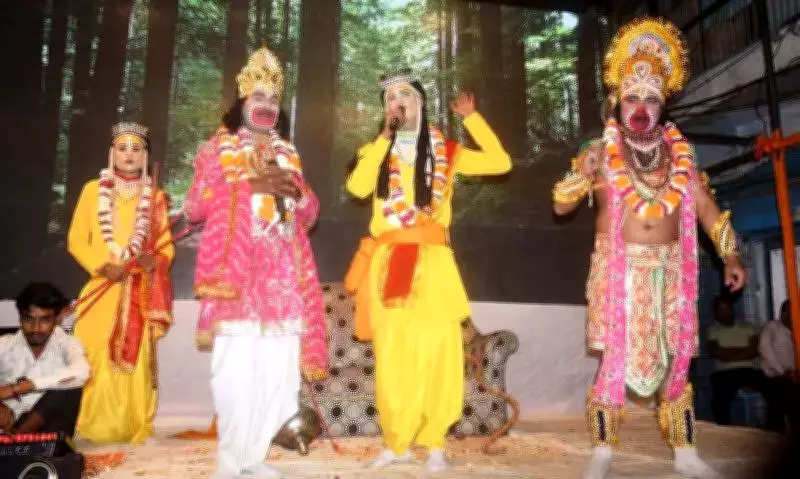
Unlike conventional Ramleelas confined to fixed stages, Bareilly's version is a magnificent moving spectacle where the entire urban landscape becomes an immersive stage. Processions wind through narrow lanes and bustling markets, bringing vivid episodes from the Ramayana directly to the people's doorsteps. "The tradition dates back to 1861, when a group of children initiated it. Over decades, it evolved into a grand community celebration attracting thousands," explained Akhilesh Agarwal, in-charge of the Ramleela committee. "This Ramleela does not stay in one place. The city itself transforms into Ayodhya, Mithila, and Lanka, with every neighborhood depicting scenes from the epic."
The Grand Narrative Unfolds Over 19 Days
The festivities commence at the Nrisinh Temple in Bamanpuri with Ganesh pujan and a ceremonial flag procession. From this starting point, the narrative unfolds over nearly 19 days, beginning with Narad Moh and Ram Janm. As the story progresses, dramatic episodes such as Sita's birth, Vishwamitra's arrival, and the slaying of Tadaka are enacted in different parts of the city, creating a living, breathing theatrical experience.

Highlights: Ram Baraat and Symbolic Processions
The pinnacle of the celebration is the grand Ram Baraat, a nearly 10-kilometer-long procession held a day before Holi. "This year marks its 166th edition. Thousands of devotees walk alongside beautifully decorated chariots carrying artistes portraying Lord Ram, Lakshman, Sita, and Bharat," described a participant. The procession, starting from Nrisinh Temple and passing through key city areas, sees participants play with colors, with even security personnel often covered in hues by evening.
Following the Ram Baraat comes the unique 'Kevat Ki Naav' procession, symbolizing Lord Ram's river crossing during exile, which also travels across the city. Later, the emotional Bharat Milap occurs, where two separate processions representing Lord Ram and Bharat start from different corners and meet at a common point, celebrated with colors and embraces in the spirit of Holi Milan.
Conclusion and Community Harmony
The celebrations continue with episodes like Lanka Dahan, Meghnad Vadh, and finally Ravan Vadh, concluding with Ram Rajyabhishek marking Lord Ram's coronation. Another grand procession, the Ram Tilak Yatra, draws nearly 8,000 participants and signals the end of the 15-day celebration.
Remarkably, this Ramleela reflects a profound spirit of harmony. Processions pass near the Ala Hazrat Dargah and other Muslim-dominated localities, where residents welcome them warmly. Despite often coinciding with Ramzan, celebrations proceed peacefully. SP City Manush Parekh noted, "We deploy police and PAC forces as a precaution, but the people of Bareilly host the event with love and respect. There has never been major tension."
UNESCO Recognition and Global Acclaim
In 2008, UNESCO included Bareilly's Holi-time Ramleela in its Representative List of the Intangible Cultural Heritage of Humanity, acknowledging its long cultural continuity and strong community participation. This honor has placed Bareilly's unique tradition on the global cultural map, celebrating its enduring legacy and vibrant communal spirit.