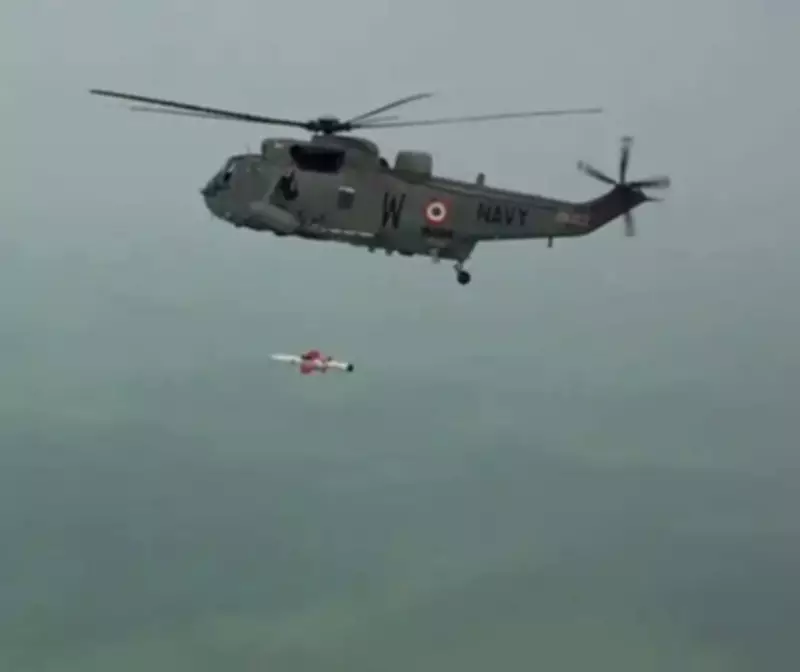
In a significant boost to the Indian Navy's anti-ship warfare capabilities, the Defence Research and Development Organisation (DRDO) and the Indian Navy successfully launched the Naval Anti-Ship Missile-Short Range (NASM-SR) from a helicopter platform in the Bay of Bengal, off the coast of Odisha. The test took place on Wednesday, marking a major milestone in indigenous missile development.
Historic Salvo Launch
During the trial, two missiles were launched in quick succession from the same helicopter, achieving the first salvo launch of an advanced air-launched anti-ship missile system, according to the defence ministry. This capability allows for multiple missiles to be fired in rapid succession, enhancing the probability of mission success against enemy targets.
Indigenous Technology
NASM-SR is India's first indigenously developed air-launched anti-ship missile. It features advanced low-level sea-skimming technology, which allows it to fly close to the sea surface to evade enemy radar detection. The missile has a range of 55 kilometres and supports fire-and-forget operation in all weather conditions and at all hours, making it a versatile and reliable weapon system.

Test Objectives Fully Met
All test objectives were fully met, as confirmed by data captured using various range-tracking instruments deployed by the Integrated Test Range (ITR) in Chandipur. These instruments included radar, electro-optical systems, and telemetry. Along with proving the salvo launch capability, the missiles demonstrated waterline hit capability, meaning they can precisely strike a target vessel at or just below the waterline, causing maximum damage.
Defence Minister's Praise
Defence Minister Rajnath Singh complimented the DRDO, the Indian Navy, the Indian Air Force (IAF), and the industry partners for the successful launch. He stated that the development of this missile will further enhance the capabilities of the defence forces, contributing to national security.
Witnesses and Partners
The test launch was witnessed by senior scientists from the DRDO, representatives from the Indian Navy and the IAF, and development-cum-production partners. The successful trial underscores India's growing self-reliance in defence technology and its commitment to strengthening the armed forces with indigenous systems.