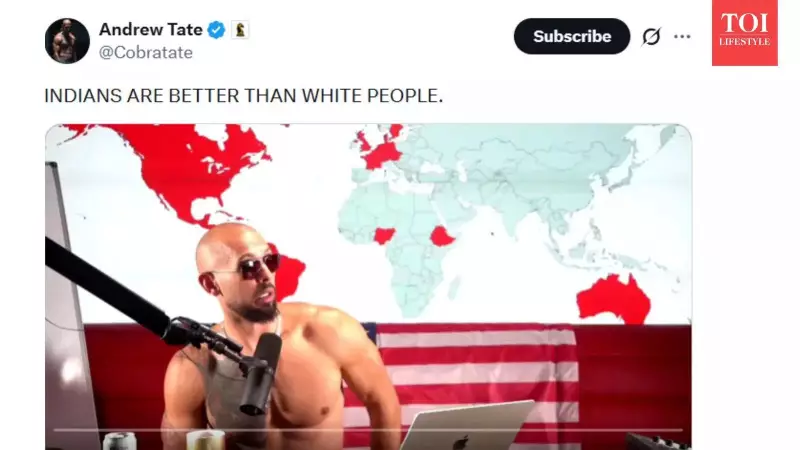
Andrew Tate, the internet personality known for his polarizing views, has once again set social media ablaze. This time, the controversy stems from a video he posted on X (formerly Twitter) where he makes the provocative claim that "Indians are better than white people." The clip, laden with explicit language, has triggered a massive wave of reactions across platforms like X, Instagram, and YouTube, racking up millions of views and dividing netizens worldwide.
What Exactly Did Andrew Tate Say in the Viral Clip?
In the now-viral monologue, Tate launches into a profanity-filled rant ostensibly defending Indians from online mockery. He contrasts Indian men, whom he portrays as having strong family values and resilience despite economic hardships, with young white men in the West. Tate accuses the latter of loneliness, consumerism, and dependency on modern financial systems.
His crude language targeted Western dating culture, using derogatory terms to insult women and modern lifestyles. A central part of his argument was: "Everyone makes fun of Indians... but he has kids. You don't. You're a 28-year-old white male... Indian has babies. You ain't got shit." He concluded by stating, "You white people are clowns."

While framed as a defence, critics were quick to point out that his argument relied heavily on racial caricatures and degrading stereotypes about poverty, hygiene, and culture, ultimately crossing into what many called racist and misogynistic abuse.
A Stark Contrast to Tate's Past Remarks on India
This sudden praise for Indians stands in sharp contrast to Tate's own history of comments about the country. Previously, in various podcasts and social media posts, Tate has repeatedly mocked India and its people, often employing crude stereotypes related to poverty and infrastructure while dismissing the nation as inferior to the West.
This rhetorical pivot has led many commentators to believe his latest video is less about genuine respect and more about provocation. Analysts suggest he is using any comparison—positive or negative—that best serves his broader attacks on Western society, modern masculinity, and feminism, which are hallmarks of his online persona.
Mixed Reactions and the 'Rage Bait' Accusation
The reaction on Indian social media and globally has been sharply divided. Some users expressed a cautious appreciation for someone with a large platform calling out the racist mockery often faced by South Asians online.
However, a far louder chorus rejected his 'praise.' Many Indian netizens argued that being used as a prop in a culture war built on insults and stereotypes is not solidarity. "This isn't solidarity, it's rage bait," became a common refrain on X and Reddit, accusing Tate of exploiting racial discourse purely for engagement.
Women's rights advocates and anti-racism groups universally condemned the video for its dehumanizing language towards women and its reinforcement of harmful tropes. Several platforms flagged the content for hate speech, though reposts continued to circulate widely.
The Familiar Tate Playbook: Outrage as a Business Model
This incident fits a familiar pattern for Andrew Tate. Following platform bans and legal troubles, he consistently uses shock-value rhetoric to polarize audiences and regain relevance. "Outrage is the business model," noted one observer, highlighting that both criticism and support serve to amplify his content.
The timing is also strategic, tapping into global online debates about masculinity, loneliness, and demographic change, particularly among young men. His framing, while presented as social commentary, has been criticized as an insult that conflates masculinity, reproduction, and personal worth.
The bottom line is that Andrew Tate's viral claim has successfully reignited a global culture war, fuelled by shock and polarization. While he positions himself as a critic of Western decline, the episode has been widely condemned for promoting racial stereotypes and misogyny. As the internet continues to argue and share the clip, one thing is clear: the controversy itself was precisely the point, demonstrating how inflammatory rhetoric continues to thrive in today's attention economy.