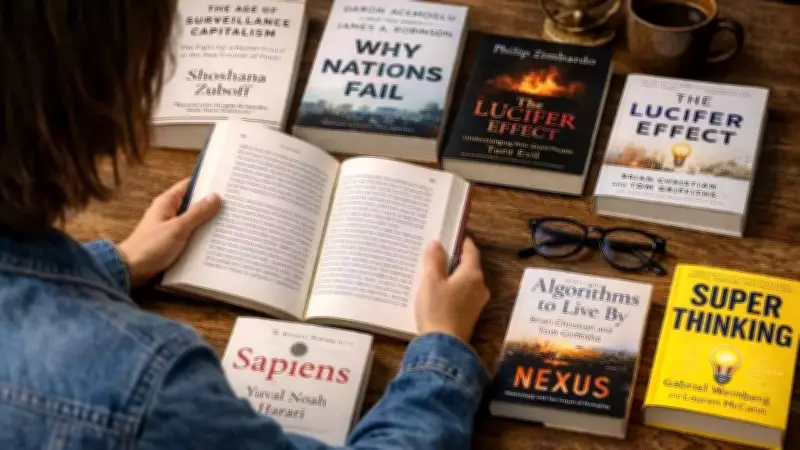
7 Transformative Books That Will Change Your Worldview Forever
In today's information-saturated world, where data flows endlessly but genuine understanding remains elusive, certain literary works stand apart by fundamentally altering our perception of reality. These are not mere collections of facts but profound explorations that reshape how we comprehend society, technology, history, and human behavior. Reading them doesn't just add to your knowledge—it transforms the very lens through which you view existence.
Many readers describe finishing these books as feeling "overeducated," not in the sense of knowing everything, but in understanding the intricate systems that govern human life. By weaving together history, psychology, economics, and technology, these works illuminate the hidden mechanisms driving our world.
The following seven books are renowned for expanding intellectual horizons, challenging deep-seated assumptions, and stimulating critical thought about societal evolution and function.

Sapiens: A Brief History of Humankind by Yuval Noah Harari
Few contemporary works have been as groundbreaking as Sapiens in revolutionizing our understanding of human history. Yuval Noah Harari masterfully traces the journey of Homo sapiens from our earliest ancestors to the current technological age, creating a compelling narrative that blends anthropology, biology, and history into a seamless whole.
Harari's central thesis posits that humanity's ascent to planetary dominance stems from our unique ability to create and believe in shared stories—whether religious, national, or economic. The book forces readers to question long-held assumptions about progress, civilization, agriculture, capitalism, and scientific revolutions, offering a radically new perspective on what it means to be human.
The Age of Surveillance Capitalism by Shoshana Zuboff
In our digital era, personal data has emerged as one of the world's most valuable commodities. Shoshana Zuboff's The Age of Surveillance Capitalism provides a meticulous examination of how technology corporations harvest personal information and repurpose it for profit.
Zuboff reveals how these companies have engineered an entirely new economic system where human experiences are transformed into behavioral data, sold and utilized to predict and influence future actions. This thorough analysis exposes the profound impact of digital platforms on personal autonomy, leaving readers permanently altered in their approach to online activities.
Algorithms to Live By: The Computer Science of Human Decisions by Brian Christian and Tom Griffiths
This fascinating work explores a compelling premise: the algorithms computers use to solve complex problems can actually enhance human decision-making. Drawing from computer science and cognitive psychology, the book demonstrates how algorithmic principles can optimize information search, task organization, and time management.
From determining optimal stopping points in searches to improving scheduling efficiency, Algorithms to Live By reveals unexpected connections between technological processes and human cognition, providing practical tools for navigating life's complexities.
Super Thinking: The Big Book of Mental Models by Gabriel Weinberg and Lauren McCann
In an era of information overload, clear thinking has become an invaluable skill. Super Thinking introduces readers to powerful mental models—conceptual frameworks borrowed from economics, psychology, physics, and other disciplines that help simplify complex problems.
What distinguishes this book is its emphasis on practical application rather than theoretical discussion. Whether making business decisions or personal choices, these mental models provide structured approaches to problem-solving that enhance clarity and effectiveness.
Why Nations Fail: The Origins of Power, Prosperity, and Poverty by Daron Acemoglu and James A. Robinson
This influential study tackles one of humanity's most persistent questions: why do some nations thrive while others remain impoverished? Acemoglu and Robinson argue convincingly that economic success stems not from geography, culture, or natural resources, but from political and economic institutions.

Nations with inclusive institutions that encourage broad participation, innovation, and equitable opportunity distribution tend to prosper, while those with extractive institutions concentrating power and wealth among elites typically stagnate. Through historical examples spanning centuries, the book demonstrates how institutional frameworks shape national destinies.
Nexus: A Brief History of Information Networks from the Stone Age to AI by Yuval Noah Harari
In Nexus, Harari examines the accelerating convergence of artificial intelligence, information technology, and global power structures. The book explores how both human and artificial information networks will determine civilization's future trajectory.
Harari analyzes how emerging technologies—particularly AI—will transform politics, economics, and warfare. Neither utopian nor dystopian, this nuanced work challenges readers to contemplate technology's profound implications with careful, critical thought.
The Lucifer Effect: Understanding How Good People Turn Evil by Philip Zimbardo
Psychologist Philip Zimbardo investigates one of human behavior's most disturbing aspects: how ordinary individuals can commit harmful acts under specific circumstances. Centered on the infamous Stanford Prison Experiment of 1971—where participants assigned as guards or prisoners rapidly exhibited alarming aggression—the book demonstrates how situational forces can override personal morality.
Zimbardo compellingly argues against the "bad apple" theory of evil, showing instead how systemic conditions can lead average people toward unethical behavior. This profound exploration of human nature remains critically relevant to understanding contemporary social dynamics.
Together, these seven works represent essential reading for anyone seeking to deepen their understanding of the world. They don't merely inform—they transform, offering intellectual frameworks that permanently alter how we perceive reality and our place within it.