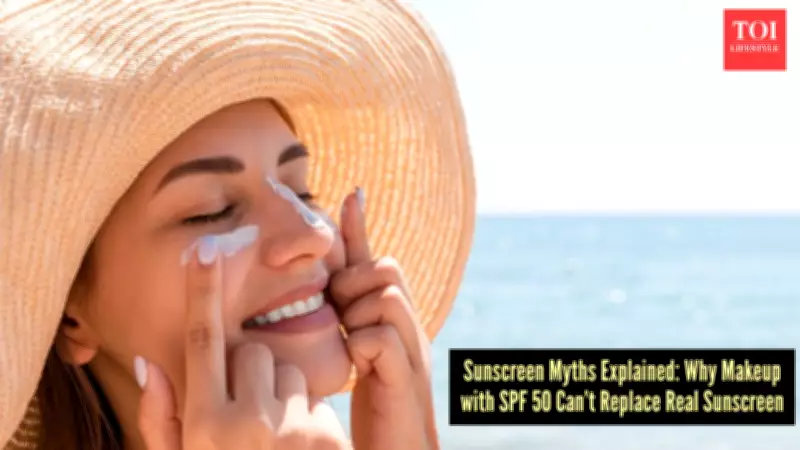
The Hidden Dangers of Relying on SPF Makeup for Sun Protection
We all appreciate products that serve multiple purposes. A moisturizer that also primes the skin, a tint that provides hydration, or the ultimate beauty marketing promise: a foundation offering high-level sun protection. Seeing "SPF 50" printed on your favorite makeup bottle feels reassuring, like a safety net suggesting you can skip a separate sunscreen and still be fully protected when stepping outside. However, dermatologists and cosmetic chemists deliver a crucial warning. While that added SPF is a beneficial bonus, depending on it as your only source of protection is a dangerous gamble. Here is an in-depth look at why your makeup bag might be leaving you vulnerable to significant sun damage.
The Mathematical Shortfall of Makeup-Based SPF
The primary issue with sun protection in makeup comes down to basic mathematics. To achieve the SPF number stated on the label, whether it is a sunscreen or a foundation, you must apply the product at a density of two milligrams per square centimeter of skin. Practically, this translates to roughly a quarter to half a teaspoon for your face alone. Imagine a nickel-sized dollop of thick foundation. Now, picture applying that entire amount to your face. For most individuals, that quantity would appear excessively cakey and feel uncomfortably heavy. Research indicates that the average consumer applies only about 25 to 50 percent of the recommended amount of makeup. Unfortunately, sun protection does not operate on a linear scale. Applying half the amount does not yield half the protection. If you use a thin layer of SPF 50 foundation, you might actually receive protection closer to SPF 5 or SPF 10. That is barely sufficient to prevent a sunburn, much less long-term damage like premature aging or skin cancer.
The Swiss Cheese Effect: Gaps in Coverage
Sunscreen functions most effectively when it forms a uniform, continuous film over the skin. When we apply makeup, we typically buff, blend, and sheer it out to achieve a natural appearance. We often avoid areas like the hairline, ears, eyelids, and jawline to prevent staining hair or clothing. This creates what experts term the "Swiss cheese" effect. You might have coverage in certain spots, but there are microscopic gaps and holes in others where UV radiation can penetrate directly. A dedicated sunscreen is usually applied more liberally and evenly, ensuring those high-risk zones are covered before any pigment touches your face, providing a more reliable shield against harmful rays.

The Challenge of Reapplication with Makeup
We are aware that sun protection ingredients degrade after approximately two hours of UV exposure. The golden rule of skincare is regular reapplication. However, let us be realistic about how this works with makeup. Are you likely to wash your face and reapply a full layer of foundation every two hours while at your desk or running errands? Probably not. While powder sunscreens exist for touch-ups, they face the same volume issue as liquid foundation. To obtain the labeled protection, you would need to apply so much powder that your skin would appear chalky and unnatural, making it impractical for daily use.
Makeup Formulation: Protection as a Secondary Feature
Ultimately, a foundation is formulated primarily to provide color, texture, and finish. Sun protection is often a secondary add-on. Incorporating UV filters into a pigment-heavy formula can sometimes compromise how effectively those filters spread across the skin compared to a pharmaceutical-grade sunscreen designed specifically for protection. Moreover, while many foundations block UVB rays, which cause burning, they may not always offer broad-spectrum protection against UVA rays, which are responsible for aging and deep cellular damage, increasing the risk of skin issues over time.

Building the Right Skincare Routine
Does this mean you should discard your SPF makeup? Absolutely not. Think of the SPF in your foundation as the icing on the cake, but remember that the cake itself must be a dedicated sunscreen. The optimal routine is straightforward. Begin with a clean canvas by washing and moisturizing, then apply a substantial layer of broad-spectrum sunscreen. Aim for SPF 30 or higher for genuine safety. The key is to wait a few minutes for it to set into a protective shield. Once it dries down, apply your makeup as usual. This approach allows you to maintain a flawless look while ensuring your skin remains safeguarded against sun damage.