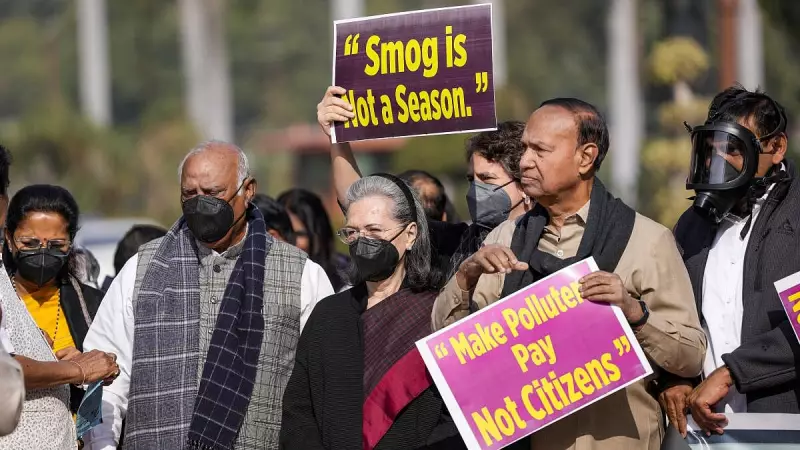
Senior Congress leader Sonia Gandhi has issued a strong appeal to the government, calling for immediate and decisive steps to tackle the severe air pollution crisis gripping the national capital. Speaking in Parliament, she highlighted the acute suffering of vulnerable populations, including the elderly and children, due to the toxic air.
An Urgent Plea from Parliament
During a session in the Lok Sabha, Sonia Gandhi voiced deep concern over the deteriorating air quality in Delhi. She framed the issue as a matter of grave public health, emphasizing that it transcends political divisions. "This is not a political issue but an issue related to the health of the public," she stated, urging all parties to come together to find a solution.
Drawing from personal concern, she pointed out the disproportionate impact on sensitive groups. "Old people like me are finding it very difficult. What will happen to small children?" she asked, underscoring the daily struggle faced by millions of residents in the city. Her remarks put a human face on the statistical data reported by pollution monitoring agencies.

The Grim Reality of Delhi's Air
The context of her appeal is a period of consistently "very poor" to "severe" air quality levels in Delhi and the broader National Capital Region (NCR). Monitoring stations have repeatedly recorded dangerous concentrations of particulate matter (PM2.5 and PM10), far exceeding safe limits prescribed by the World Health Organization.
This toxic haze, a complex mix of vehicular emissions, industrial pollution, dust, and seasonal agricultural stubble burning from neighboring states, engulfs the city annually. It leads to a surge in respiratory illnesses, reduced visibility, and a general advisory for people, especially those with pre-existing conditions, to limit outdoor exposure.
A Call for Concerted Government Action
Sonia Gandhi's intervention in Parliament serves as a direct challenge to the ruling administration. Her statement is a call for the government to move beyond acknowledging the problem and to implement effective, enforceable measures. The demand implies a need for:
- Stringent enforcement of existing pollution control norms.
- Enhanced coordination between Delhi and surrounding state governments to address trans-boundary causes like stubble burning.
- Accelerated promotion of public transport and cleaner energy sources.
- Clear, actionable plans for protecting the most vulnerable citizens during peak pollution episodes.
While the government has initiated various steps under its Graded Response Action Plan (GRAP), critics, including opposition voices, argue that the response is often reactive and insufficient to tackle the root causes of the annual crisis.
The Congress leader's poignant question—"What will happen to small children?"—resonates as a stark reminder of the long-term health implications of the pollution crisis. It frames the issue not just as an environmental or administrative failure, but as a direct threat to the future well-being of the country's youth and the dignity of its elderly.
As Delhi continues to grapple with its toxic air, such high-profile appeals increase pressure on authorities to treat the situation with the urgency of a public health emergency. The coming weeks will reveal whether this parliamentary appeal translates into more robust and visible action on the ground.