

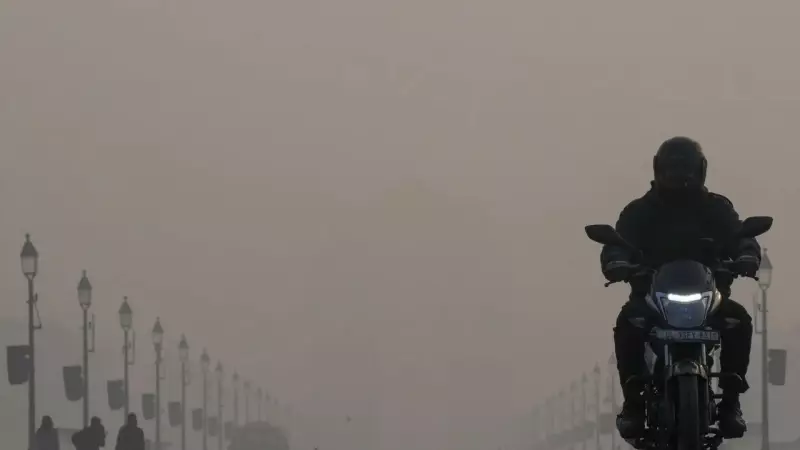
Delhi's air quality remained firmly in the 'very poor' category on Wednesday, with a dense layer of toxic smog continuing to shroud large parts of the national capital, including iconic areas like India Gate. The city's overall Air Quality Index (AQI) was recorded at 349, as per data from the Sameer app.
Pollution Hotspots Across the Capital
Data from the Central Pollution Control Board (CPCB) revealed several severe pollution hotspots. Mundka recorded the highest AQI at 385, closely followed by Okhla at 382, RK Puram at 376, Punjabi Bagh at 373, and Wazirpur at 372. All these readings fell under the 'very poor' classification.
While the AQI showed a slight improvement from Tuesday morning's severe level of 414, the situation has deteriorated sharply compared to Sunday evening, when the index was at 377. This indicates a significant worsening of air quality over a 48-hour period.

Travel Disruptions and Government Action
The dense fog and smog combination caused significant travel disruptions. According to PTI reports, several trains were running behind schedule, and a number of flights were delayed due to the poor visibility conditions, inconveniencing many passengers.
Meanwhile, Delhi's Environment Minister, Manjinder Singh Sirsa, announced stringent measures to combat vehicular pollution. He stated that the 'No PUC, No Fuel' policy will continue in the national capital even after the Graded Response Action Plan (GRAP)-IV restrictions are lifted. This is part of sustained efforts to curb emissions from vehicles.
Crackdown on Polluters
Addressing a press conference, Minister Sirsa detailed the enforcement drive. The government has tightened actions against errant pollution testing centres. Twelve Pollution Under Control Certificate (PUCC) centres involved in irregularities have been suspended and are set to be blacklisted under the ongoing drive.
On the industrial front, the Delhi Pollution Control Committee (DPCC) has issued 411 closure notices to check harmful emissions. Additionally, the Municipal Corporation of Delhi (MCD) has taken strong action by sealing 400 polluting units so far.
The combined data and government actions paint a picture of a city grappling with a persistent air quality crisis, where temporary relief is overshadowed by a longer-term pattern of hazardous pollution, demanding continuous and rigorous intervention.






