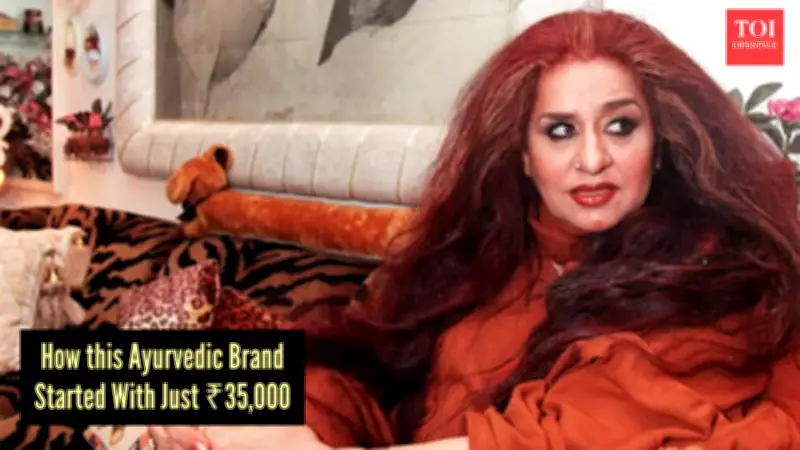
We talk endlessly about 'clean beauty' today. It is slapped on every other serum at the mall. But decades before it was a highly profitable hashtag, a teenager in Delhi was quietly grinding plant extracts on her veranda.
A Life Less Ordinary
Shahnaz Husain was married at 15. She had her first child at 16. For most women in her era, that was the entire script. The story was written. She, however, desperately wanted out of the ordinary.
The European Pivot
She made her way to Europe to study cosmetology. You would think the upscale salons of London and Paris are where she found her grand vision, but what she actually found was a massive problem. She saw firsthand how harsh, chemical-heavy treatments were quietly ruining skin. It bothered her. It bothered her enough to look backward instead of forward—straight into the heart of Indian Ayurveda.

She returned to India, borrowed exactly INR 35,000 from her father, and claimed a corner of her house. There was no factory. No venture capital. Night after night, she hand-mixed herbal extracts, poured the remedies into jars, and stuck the labels on herself. She did not bother with mass-market advertising. Instead, she offered personalized 'care and cure' routines. Word of mouth did the heavy lifting.
Turning Housewives into Bosses
By 1979, demand was out of control. Husain could have easily opened massive, impersonal corporate clinics. Instead, she did something completely different: she franchised her model to homemakers. She trained everyday women to open small salons right out of their own living rooms. It was a genius move. She was not just expanding a brand; she was handing women a blueprint for financial independence. They were not just selling herbal facials. They were running their own businesses.
From a Porch to Paris
The international breakthrough happened in 1980 during the Festival of India in London. Husain managed to secure a tiny counter at Selfridges. Three days later, her entire inventory was completely wiped out. That weekend was a skeleton key for the luxury retail world. Soon, her Ayurvedic treatments were sitting on shelves in Harrods, Galeries Lafayette in Paris, and La Rinascente in Milan. Today, the brand operates in over 100 countries and makes hundreds of different products.
Keeping It Human
Despite the massive scale, the company rarely feels like a faceless corporation. Husain built a habit of answering customer letters personally. More importantly, she used her leverage to build free vocational academies. Programs like Shamute for the speech and hearing impaired, and Shasight for the visually impaired, have given tens of thousands of people the practical skills to earn a living in the beauty industry.
It earned her a Padma Shri. It landed her in Harvard Business School case studies. It is a rare trajectory. She proved that to disrupt a multi-billion dollar industry, you do not necessarily need a boardroom. Sometimes you just need a veranda and the stubborn belief that nature does it better.