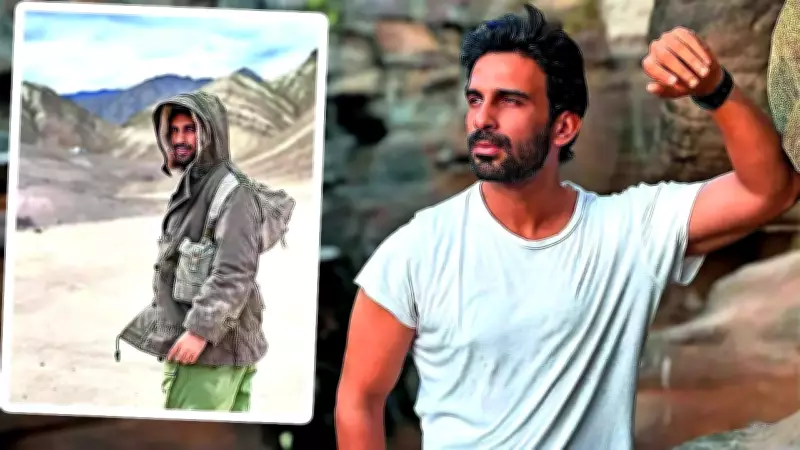
Television actor Ankit Siwach, known for his popular roles on the small screen, recently made headlines with his visit to Lucknow and reflections on his impactful performance in the film 120 Bahadur. In an exclusive conversation, Siwach delved into the personal and professional milestones that have shaped his journey in the entertainment industry.
Portraying a Soldier in 120 Bahadur: A Dream Realised
Ankit Siwach was last seen in the film 120 Bahadur, where he played the role of Sepoy Ramlal Yadav, the signal man and lone survivor of the Battle of Rezang La during the 1962 Sino-Indian War. For Siwach, this role held deep personal significance. "This is the first time I’m playing a soldier," he shared. "I was born in Meerut Cantt and grew up around that environment, so I’ve always felt an emotional connection to the military. Wearing the uniform for this film felt like a dream realised."
Intensive Training and Casting Journey
The actor underwent an intensive three-month training regimen to prepare for the role, which included physical workouts, mental preparation, body language adjustments, and diction coaching. "The entire battalion has a specific way of speaking, so it was intensive and unique training for all of us," Siwach explained. Interestingly, his casting journey had an unexpected twist. He auditioned without knowing the project details, assuming he hadn't been selected until a week later when he received a call confirming his role. Only then did he learn it was a Farhan Akhtar production based on the Battle of Rezang La.

Audience Love Over Box-Office Metrics
Reflecting on the film's reception, Siwach emphasized that the audience's heartfelt love and respect overshadowed traditional box-office metrics. "Since the first screening of 120 Bahadur, I sensed a flow of strong energies, a sense of respect that the audience felt for the film and everyone involved in it," he said. "I realized that I was only looking for love for what we had created. I got what I was seeking—the audience’s love and respect for my work. I am not a believer of chasing fame, but looking for reality in people’s eyes. In this case, I saw real love, real applause, honest hugs, and professional validation."
First-Time Visit to Lucknow: A Cherished Experience
Turning to his recent trip to Lucknow, Siwach described it as long overdue but worth the wait. "I had never been to Lucknow earlier; this was my first time," he revealed. "I've visited Banaras and Kanpur, but never Lucknow. My brother was once posted here, but I couldn't come at that time." During his visit, he explored Hazratganj, indulging in local delicacies like chaat, kebabs, and tea. "We had a blast! The people here are so warm and welcoming. Everything was fabulous, and I'll cherish that one-and-a-half-day trip for a long time," he added with enthusiasm.
Navigating OTT and Theatrical Cinema
On the evolving landscape of entertainment, Siwach shared his philosophy on balancing projects amid the rise of OTT platforms and theatrical cinema. "The dynamics of filmmaking and the industry have paced up evolution worldwide," he noted. "There is so much to catch up to that it doesn’t give us time to analyze much, rather practice 'being' and 'doing'. Right now, my focus is to get into the best possible films and OTT projects. There is no high better than getting to perform in well-made and well-intended films and shows."
Future Focus and Professional Growth
Siwach emphasized his commitment to selective, high-impact projects. "As the journey continues, I am flowing with utmost honesty and hard work, but this time, more equipped to take up the biggest responsibilities," he stated. His approach centers on chasing authentic validation over fleeting fame, aiming to stay relevant through meaningful work regardless of the medium.
Ankit Siwach's experiences from 120 Bahadur to his Lucknow adventure highlight a career built on passion, dedication, and a deep connection to his roots. As he navigates the fast-changing entertainment industry, his focus remains on delivering performances that resonate with audiences and uphold the integrity of storytelling.