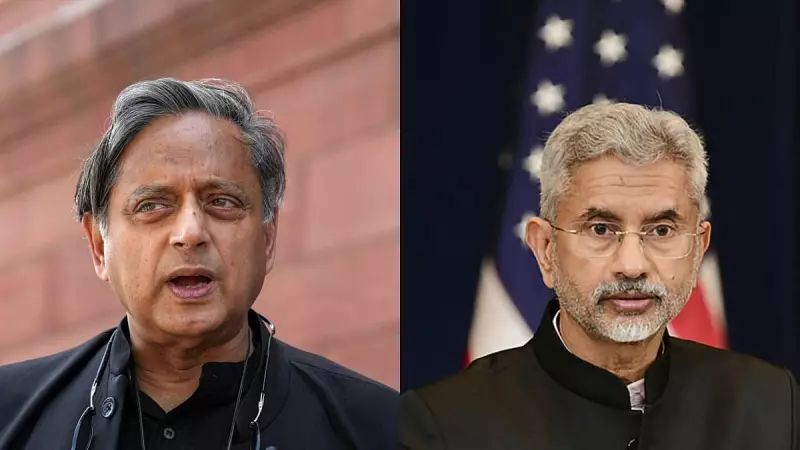
In a notable display of cross-party appreciation, senior Congress leader and Member of Parliament Shashi Tharoor has publicly commended External Affairs Minister Dr. S. Jaishankar and the Ministry of External Affairs (MEA) for their pivotal, yet often overlooked, contributions to the revival of the ancient Nalanda University. Tharoor's praise highlights a rare moment of political unity centered on a project of immense national pride and cultural significance.
Acknowledgment in the Rajya Sabha
Tharoor, who represents Thiruvananthapuram in the Lok Sabha, extended his commendation during a session in the Rajya Sabha on July 29. He specifically lauded the diplomatic and administrative efforts spearheaded by the MEA under Jaishankar's leadership, which were instrumental in navigating the complex international partnerships and bureaucratic processes required to resurrect the historic seat of learning.
The revival of Nalanda University, located near Rajgir in Bihar, stands as one of India's most ambitious projects in the realm of education and soft power. Its modern iteration, established by a special act of Parliament in 2010, aims to reclaim its legacy as a global center for intellectual and spiritual exchange. Tharoor emphasized that while the university's academic vision is widely celebrated, the foundational work done by the foreign ministry does not receive the public recognition it deserves.

The Unsung Diplomatic Endeavor
The path to rebuilding Nalanda was fraught with diplomatic and logistical challenges. The project required sustained engagement with member countries of the East Asia Summit (EAS), from which the initiative originally emerged. The MEA played a critical role in fostering international cooperation, securing commitments, and managing the multilateral framework that supports the university.
Tharoor pointed out that the foreign ministry's consistent backend support ensured the project's continuity and helped translate a grand vision into a tangible institution. This involved everything from high-level diplomatic negotiations to handling the practicalities of international grants and collaborations. By highlighting this, Tharoor shifted the spotlight onto the often-invisible machinery of governance that enables such landmark achievements.
Transcending Political Divides
This public acknowledgment is significant in the current climate of intense political rivalry. Tharoor, a former Minister of State for External Affairs himself, is known for his expertise in diplomacy and international relations. His praise for Jaishankar, a key figure in the BJP-led government, underscores a shared commitment to projects that embody India's civilizational heritage and its aspirations on the world stage.
The gesture suggests that certain national interests, particularly those related to education, culture, and India's global standing, can transcend partisan politics. It sets a precedent for recognizing governmental work based on merit and outcome, rather than political affiliation.
The Legacy and Future of Nalanda
The original Nalanda University, dating back to the 5th century CE, was a legendary mahavihara (great monastery) and a magnet for scholars from across Asia. Its destruction in the 12th century marked the end of an era. The new Nalanda University, inaugurated in 2014, seeks to be a modern, interdisciplinary, and sustainable institution focused on fields like historical studies, ecology, and Buddhist studies.
The university is not just an educational facility; it is a powerful symbol of India's intellectual renaissance and its role as a 'Vishwa Guru' (world teacher). The successful revival, therefore, carries profound symbolic weight, making the MEA's role in its facilitation all the more critical.
Tharoor's comments serve as a reminder that nation-building is a collaborative effort. While political leaders and academics are often at the forefront, the dedicated work of civil servants and diplomats provides the essential scaffolding. His praise for Jaishankar and the MEA reinforces the idea that credit should be given where it is due, fostering a healthier political discourse centered on national achievements.

As Nalanda University continues to grow and attract students from around the world, the story of its revival will remain a testament to sustained diplomatic effort and a rare consensus in Indian politics. Tharoor's laudatory words have now officially etched the MEA's contribution into the public record of this monumental project.