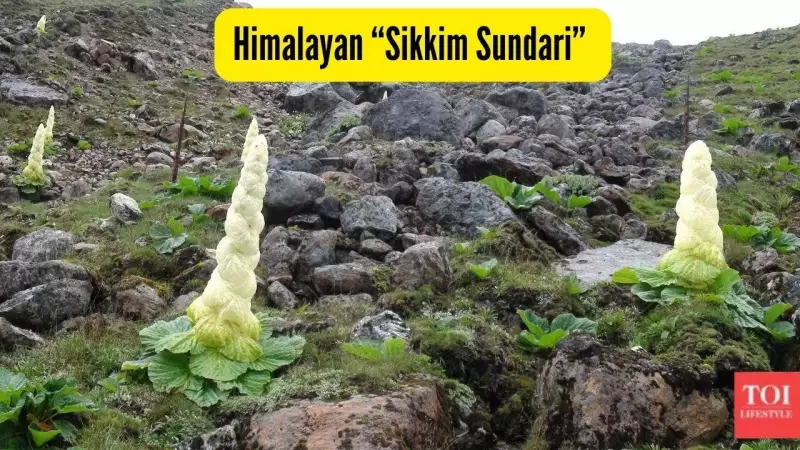
When one of India's most prominent industrialists shares a discovery from the remote Himalayas, the nation takes notice. Anand Mahindra, Chairman of the Mahindra Group, recently captivated his vast audience on social media platform X (formerly Twitter) with a post about a breathtaking and rare botanical wonder: the Sikkim Sundari.
The 'Extraordinary Marvel' That Stunned a Tycoon
Expressing his awe, Mahindra admitted he previously knew nothing about this high-altitude phenomenon. He described the plant, which thrives at an astonishing 4,000 to 4,800 metres above sea level, as a "Glasshouse Plant" that stands like a glowing tower against the mountain backdrop. He called its life cycle a masterclass in patience, a sentiment that resonated deeply with his followers.
Scientifically known as Rheum nobile, the Sikkim Sundari is a true spectacle of nature. Its most striking feature is a translucent, pagoda-like structure that forms its bloom. What makes it truly captivating is its incredible growth journey. The plant is monocarpic, meaning it flowers once in its lifetime and then dies.

For 7 to 30 years, it exists as a small, unassuming rosette of leaves, slowly gathering and storing energy from the harsh alpine environment. Then, in a final, dramatic act, it shoots up to a height of 2 meters, unveils its magnificent pagoda-shaped bloom, releases its seeds to the wind, and completes its life cycle. This rare display is unseen by most due to the plant's extreme and remote habitat.
Sikkim: An Underexplored Himalayan Gem
Mahindra's post brilliantly highlights why Sikkim remains a paradise for offbeat travellers. The state offers dramatic transitions in landscape within a single day, from lush subtropical forests to stark, snow-tipped alpine heights, all under the watchful gaze of Mount Kanchenjunga, India's highest peak.
The region is dotted with pristine alpine lakes like Tsomgo and Gurudongmar, and ancient Buddhist monasteries such as Rumtek, Pemayangtse, and Labrang that attract spiritual seekers. Mahindra's wonder about whether this "local legend" is featured in modern Indian school curricula has sparked conversation, adding another layer of intrigue to the plant and its home.
Planning Your Journey to See the Himalayas' Secrets
For those inspired to explore Sikkim's heights, timing and permits are key. The best visiting windows are:
- March to June: Pleasant weather, clear skies, and colourful blooms perfect for nature walks.
- September to Mid-December: Cool, dry conditions offering ethereal views of the Kanchenjunga range.
- December to February: A cold, magical period when Sikkim transforms into a snowy wonderland.
All visitors, both Indian and foreign, require a Sikkim Inner Line Permit (ILP). This is usually free and can be obtained at entry checkpoints like Rangpo or online prior to arrival.
Anand Mahindra's social media share does more than just highlight a rare flower; it pulls back the curtain on the hidden wonders waiting in India's own backyard. The Sikkim Sundari, with its decades-long patience and spectacular finale, stands as a powerful metaphor for the rewards of exploring the road less travelled, especially in the breathtaking and diverse state of Sikkim.