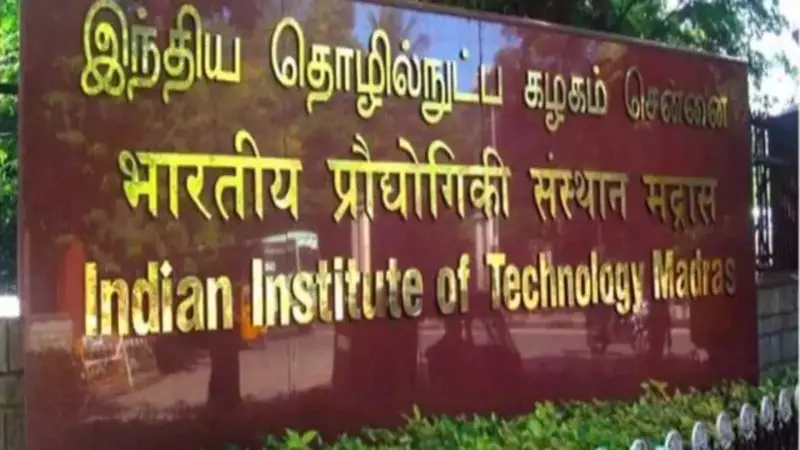
The prestigious Indian Institute of Technology Madras has taken a groundbreaking step in linguistic research by establishing the country's first Language and Cognition Laboratory. This innovative facility aims to systematically explore India's rich linguistic diversity through cutting-edge experimental methods.
A Pioneering Initiative in Linguistic Research
The Language and Cognition Laboratory, commonly referred to as LC-Lab, was officially inaugurated on November 10, 2025 by Professor V. Kamakoti, the Director of IIT Madras. Established within the Department of Humanities and Social Sciences, this laboratory represents a significant milestone in India's academic landscape as the first facility dedicated exclusively to experimental linguistics research.
According to the institute's announcement, the laboratory will employ advanced technologies including eye-tracking systems and reaction-time studies to investigate how humans perceive, process, and produce language. This interdisciplinary approach combines methodologies from science, technology, and humanities to create a comprehensive research framework.

Research Focus and Future Directions
The primary research focus of LC-Lab will center on Indian languages, providing crucial insights into grammatical structures, voice patterns, and sentence formation within multilingual environments. Current research projects are examining grammatical voice and copula constructions, while upcoming initiatives will address dyslexia in Indian children.
Professor Kamakoti emphasized the laboratory's significance, stating: "Linguistics is increasingly moving toward empirical, data-driven inquiry, combining methodologies from the sciences and humanities. India needed a dedicated facility that integrated linguistic theory with modern experimental and computational tools."
The laboratory's research objectives include:
- Short-term validation of established linguistic theories in Indian languages using eye-tracking technology
- Long-term integration of advanced neurocognitive techniques including Electroencephalography (EEG) and Transcranial Magnetic Stimulation (TMS)
- Development of educational interventions for children with dyslexia
- Creation of computational models for language processing
Collaborative Framework and Support System
The LC-Lab operates within an interdisciplinary framework that bridges multiple scientific domains. The facility plans to foster collaborations with experts in psychology, neuroscience, and artificial intelligence, creating a holistic research ecosystem that connects linguistic theory with practical applications.
The laboratory receives substantial support from IITM Pravartak Technologies Foundation and Aspire Infolab in Hyderabad, both of which have contributed significantly to its establishment and research infrastructure. This partnership ensures that the laboratory has access to state-of-the-art equipment and computational resources necessary for groundbreaking research.
The establishment of LC-Lab addresses a critical gap in India's research infrastructure by creating a dedicated space that connects linguistics with cognitive science, neuroscience, and artificial intelligence. This initiative promises to contribute significantly to the development of socially relevant, linguistically informed technologies that could transform educational outcomes and technological innovation across the country.
By focusing specifically on Indian languages and multilingual contexts, the research conducted at LC-Lab will provide unique insights that have been largely absent from global linguistic studies. The laboratory's work is expected to have far-reaching implications for education technology, cognitive science, and artificial intelligence development in India and beyond.