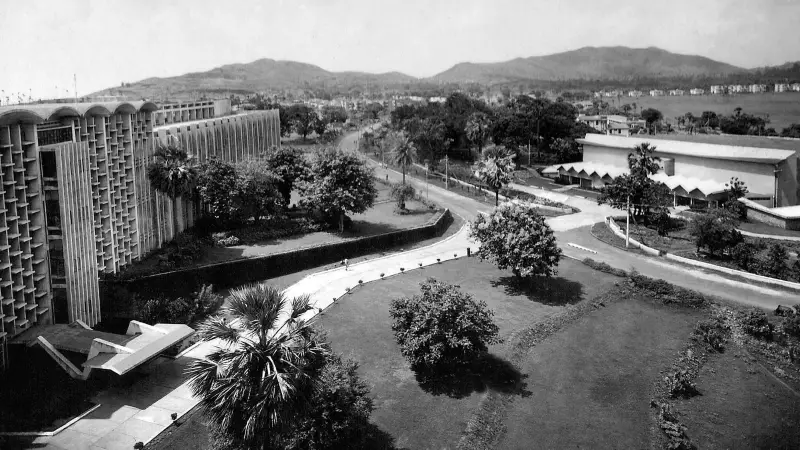
The Maharashtra government's renewed push to officially rename the Indian Institute of Technology Bombay (IIT Bombay) as IIT Mumbai has sparked a complex debate that stretches far beyond a simple change of signage. This move challenges decades of established institutional branding while tapping into a deeper historical narrative about reclaiming cultural identity. The discussion forces a re-examination of the premier institute's unique origins, its monumental contributions, and the layered history of the city it calls home.
A Legacy Forged with Soviet Support and National Vision
IIT Bombay officially opened its doors in March 1958, emerging as the second IIT in India after IIT Kharagpur. Its founding was distinct, marked by being the first IIT to receive foreign assistance. With UNESCO acting as the intermediary, the funding came not in dollars or pounds, but in Soviet Roubles from the USSR. This detail underscores the geopolitical landscape of the era and India's strategy for building scientific prowess post-independence.
The institute began humbly, with its first batch of just 100 students attending classes in Worli while its permanent campus in Powai was under construction. Its stature was cemented nationally when the Institutes of Technology Act, 1961 declared all IITs as Institutes of National Importance. Over the following decades, IIT Bombay evolved into an academic powerhouse, expanding with new departments, advanced research centres, and a robust postgraduate ecosystem.

One of its most recognizable contributions to modern India was born within its walls. The ubiquitous symbol of the Indian Rupee, ‘₹’ (Ra), was designed by former IIT Bombay PhD scholar D. Udaya Kumar. This fact ties the institute's legacy directly to a national icon, showcasing its impact beyond engineering and technology.
Mumbai vs. Bombay: A City's Centuries-Old Identity Journey
To understand the weight of the renaming proposal, one must delve into the city's own etymological evolution. Long before colonial intervention, the region finds mention in Greek sources from 250 BCE and was part of Emperor Ashoka's Mauryan empire. Its indigenous identity is deeply rooted in Mumba Devi, the patron goddess of the indigenous Koli fishing community. The name Mumbai is derived from 'Mumba' (the Mother goddess) and 'Aai' (mother), anchoring it in Marathi linguistic tradition.
The colonial chapter began in 1534 when the Portuguese took control of the seven islands and referred to them as "Bom-baim," potentially meaning "good little bay." The territory was transferred to the British Crown in 1661 as part of a royal dowry when Catherine of Braganza married King Charles II. The British East India Company later leased the islands, anglicizing the name to Bombay. It was under this name that the city grew into a major commercial hub. The official reversion to Mumbai occurred in 1995 by the state government, reasserting the city's pre-colonial heritage.
Branding Anxieties and the Procedural Hurdle Ahead
The proposal to rename the institute, while symbolically potent for many, has triggered significant apprehension. The primary concern revolves around global brand equity. "IIT Bombay" is a formidable brand recognized worldwide in academic research, international collaborations, alumni networks, and industry rankings. Stakeholders worry that altering a name built over 65 years could dilute this hard-earned prestige and cause confusion in global academic and professional circles.
Furthermore, the renaming is not a simple administrative task. Since IIT Bombay is governed by the Institutes of Technology Act, 1961, changing its official name would necessitate an amendment passed by the Parliament of India. The logistical overhaul would be massive, affecting everything from official signage, logos, and stationery to historical archives, academic records, patents, and countless research publications.

The debate, therefore, sits at a crossroads between cultural reclamation and institutional continuity. It questions whether a name change honoring regional linguistic identity can coexist with the preservation of a globally resonant brand that was itself born from a unique moment of international cooperation and national ambition.