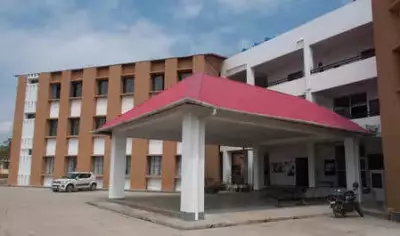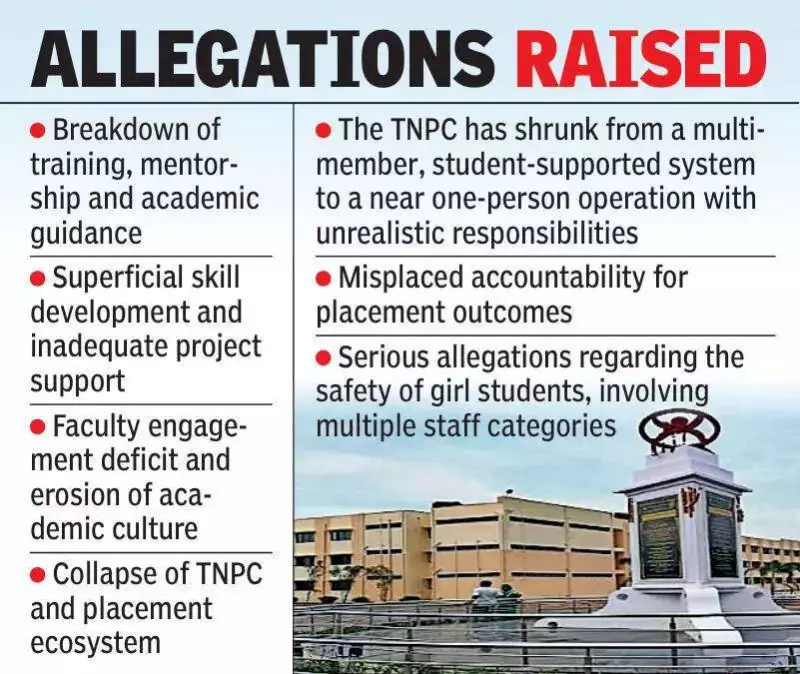
What began as an alleged harassment complaint at the Rajiv Gandhi University of Knowledge and Technologies–Srikakulam (IIIT Srikakulam) has spiraled into a revelation of deep-seated institutional problems, according to multiple sources within the premier institute. The incident has acted as a catalyst, bringing to the fore long-simmering concerns regarding student training, placements, faculty engagement, and campus safety.
Systemic Weakening of Academic and Placement Structures
Insiders describe a growing atmosphere of disappointment and frustration among students and faculty. They attribute this sentiment to what they see as a systematic weakening of academic mentoring and placement structures over several years. A critical issue highlighted is the stark mismatch between rising student intake and stagnant institutional capacity.
While the number of students admitted has consistently grown, the training infrastructure and support systems have not kept pace. This imbalance has led to a troubling "normalisation of under-preparedness" among the student body, as one source put it. The very foundation meant to equip students for competitive careers appears to be cracking.

The Stark Contrast with Nuzvid and a Shift in Focus
The sources drew a particularly unflattering comparison with the RGUKT campus in Nuzvid. There, a model of sustained, faculty-led training from the first year is reportedly yielding impressive results, with students securing high-end salary packages ranging between Rs 25 to 27 lakh per annum.
In contrast, the focus at the Srikakulam campus is alleged to have shifted. The priority, insiders claim, is now on projecting a higher quantity of placements, but primarily in the lower salary bracket of Rs 3 to 8 lakh per year. This indicates a potential compromise on the quality and prestige of job offers secured by graduates.
Erosion of the Training and Placement Cell (TNPC)
The deterioration of the Training and Placement Cell (TNPC) is cited as a prime example of the institutional decline. Previously, the cell functioned with a team of multiple dedicated members. Today, it has been reduced to what is described as a near one-person operation, severely hampering its effectiveness and reach.
This downsizing has had a ripple effect. The diminished involvement of senior students in TNPC activities has further eroded the crucial system of peer-led mentoring, which is vital for guidance and support. Additionally, promises made to students, such as organized coaching for competitive exams like GATE and consistent career guidance, have reportedly gone unfulfilled, adding to the disillusionment.
Workshops: Publicity Over Substance?
The disconnect between stated goals and ground reality is also evident in skill-development initiatives. According to the accounts, very few technical workshops offering tangible academic value have been conducted. Instead, there appears to be a greater emphasis on publicity rather than on measurable learning outcomes. This approach has left students feeling short-changed in their quest for practical, industry-relevant skills.
The recent controversy, disguised initially as a singular complaint, has thus opened a Pandora's box. It exposes a scenario where the core academic and professional promises made to students at IIIT Srikakulam are under threat, calling for urgent introspection and remedial action from the institute's administration.