For aspirants preparing for the UPSC Civil Services Mains examination, structured answer-writing practice is a critical component of success. The initiative UPSC Essentials provides a focused platform for this, covering vital topics from both the static and dynamic portions of the General Studies syllabus. In its Week 136 edition, the practice zeroes in on two significant questions from GS Paper II, offering a framework to enhance conceptual clarity and writing skills.
Question 1: India-EU FTA and the Challenge of Carbon Taxes
The first question probes the role of Free Trade Agreement (FTA) negotiations between India and the European Union in addressing complex non-tariff barriers, specifically citing the example of carbon taxes. This topic sits at the intersection of international relations, trade governance, and contemporary climate diplomacy.
The relevance is immediate. Since January 1, 2026, Indian exports of steel and aluminium to the EU have faced a new financial hurdle: the Carbon Border Adjustment Mechanism (CBAM). This EU policy imposes charges on imports based on the carbon emissions generated during their production. The impact is substantial, potentially eroding 16-22% of the actual prices received by Indian exporters and threatening India's presence in a market that absorbs about 22% of its steel and aluminium exports.

The Crucial Role of FTA Negotiations
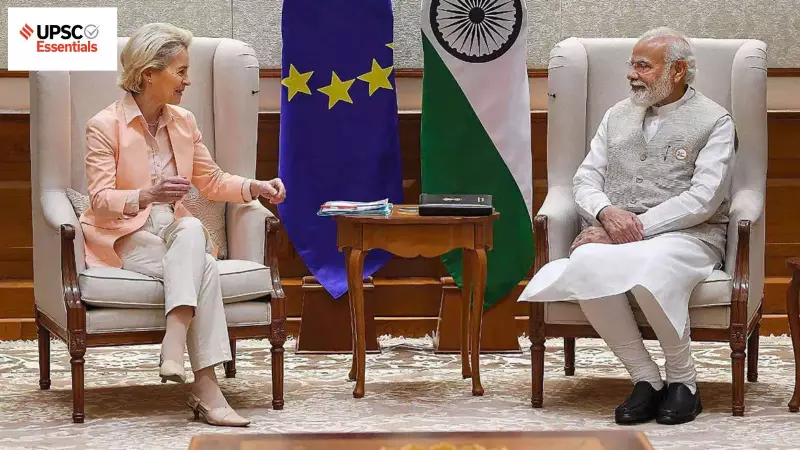
The ongoing India-EU FTA talks are pivotal in creating a framework to manage such barriers. The negotiations aim to move beyond traditional tariff discussions to tackle technical trade barriers (TBTs), sanitary measures (SPS), and crucially, mechanisms like the CBAM.
A well-structured FTA can serve as a bridge. It can foster regulatory cooperation and harmonisation of standards, potentially leading to mutual recognition of certifications and cleaner production processes. This would reduce compliance costs and complexity for Indian exporters in sectors like textiles, pharmaceuticals, and food processing. Furthermore, the FTA negotiations provide a formal diplomatic channel for India to seek resolutions and transitional measures related to the CBAM, advocating for a more equitable approach that considers the different developmental pathways of nations.
Domestically, this external pressure underscores the need for India to strengthen its own carbon accounting frameworks and incentivise greener industrial production to maintain long-term competitiveness in regulated global markets.
Question 2: Artificial Intelligence in Indian Law Enforcement
The second question requires a balanced discussion on the benefits and risks associated with deploying Artificial Intelligence (AI) in law enforcement in India. This tests understanding of technology's role in governance, internal security, and the protection of fundamental rights under the Constitution.
The context is already unfolding. For instance, the Maharashtra Police is utilising a predictive AI tool called MahaCrimeOS AI, developed with support from Microsoft. This reflects a broader trend where Indian law enforcement agencies are keenly exploring AI to manage increasing workloads, especially in cybercrime and online fraud.
Potential Benefits of AI Deployment
The primary appeal of AI lies in its capacity to process vast amounts of data at unprecedented speeds. For police forces, this translates to several operational benefits:
Enhanced Investigative Efficiency: AI systems can sift through call records, CCTV footage, financial transactions, and digital evidence to identify patterns, link disparate cases, and flag potential suspects in real-time.
Workload Management: In a scenario of uneven police resources across states, AI can act as a force multiplier, helping stretched departments manage rising caseloads without a proportional increase in manpower.
Structured Investigation: Tools like CrimeOS AI claim to offer an end-to-end workflow, ingesting evidence in multiple formats and languages, suggesting investigation paths, and even generating legal notices, thereby bringing a degree of standardisation to complex probes.

Significant Risks and Ethical Concerns
However, the integration of AI into policing is fraught with challenges that cannot be overlooked:
Perpetuation of Bias: AI models trained on historical police data risk reinforcing and amplifying existing societal and institutional biases. This could lead to the unfair targeting and over-policing of specific communities, undermining justice.
Lack of Transparency and Accountability: The "black box" nature of many AI algorithms makes it difficult to understand how decisions or predictions are made. This opacity conflicts with principles of transparent governance and makes it hard for individuals to challenge AI-driven suspicions.
Privacy and Surveillance Concerns: The use of AI-enabled tools like facial recognition in public spaces, coupled with broad exemptions for law enforcement under current data protection frameworks, raises serious questions about privacy rights under Article 21 and the potential for creating a surveillance state without adequate legal safeguards.
In conclusion, while AI presents a powerful tool for modernising Indian law enforcement, its deployment must be guided by robust legal frameworks, strict oversight, and continuous ethical auditing to mitigate risks and protect citizens' rights.
This answer-writing practice, featuring questions on the India-EU FTA and AI in policing, is designed to help UPSC candidates structure their thoughts, integrate key facts, and present balanced arguments—a essential skill for the Mains examination.