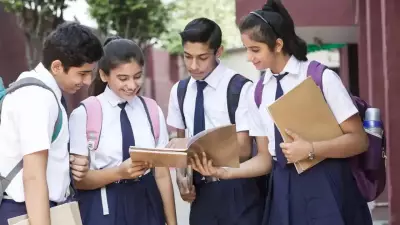
In a significant educational reform, the government of Uttar Pradesh has announced a comprehensive revision of NCERT textbooks for Class IV students across more than one lakh council-run primary schools in the state. These customised textbooks, set to be introduced from the 2026-27 academic session, are tailored to better reflect the local social, cultural, and educational milieu of Uttar Pradesh.
Mathematics and Hindi Textbooks Receive Major Updates
The revision process has notably altered the Class IV mathematics textbook, 'Ganit Mela'. In its fourth chapter, originally titled 'Humare Aaspaas Hazaron Ki Sankhya', an earlier illustration of a Jain temple located in Karnataka has been replaced. The new edition now features an image of the Shri Ram Temple in Ayodhya, with practice exercises updated accordingly to include the new context.
Furthermore, to make the content more relatable to students in Uttar Pradesh, several names and references associated with southern India have been modified. For instance, the name 'Gudappa' has been changed to 'Ganesh', and 'Muniamma' to 'Meena'. Visual references like coconut trees have been swapped with aonla trees, which are more common in the northern state.

Similar substantial changes are evident in the Hindi textbook 'Veena'. Several lessons have been swapped out entirely. The lesson 'Aasman Gira' was removed and replaced with 'Hausla' from the Basic Education Council's own 'Phulwari' textbook. The one-page lesson 'Golgappa' has made way for 'Daisy Ki Diary'. Additionally, 'Hawa Aur Dhool' has been substituted by 'Satya Ki Jeet', a lesson based on the legendary story of the truthful King Harishchandra.
Infusing Local Art, Culture, and Environmental Studies
The art textbook 'Bansuri' has been enriched with content specific to Uttar Pradesh's heritage. While it retains information on South Indian Kolam, it now also explains the tradition of Chauk Purna in Uttar Pradesh. The book highlights the famed wooden toys from regions like Chitrakoot, Varanasi, Mirzapur, and Saharanpur. It also features photographs of iconic artists such as Pandit Chhannulal Mishra of the Banaras Gharana and the renowned classical vocalist Girija Devi.
Musical references have been localised, with folk songs and styles like Kajri, Barahmasa, Ganga Geet, and a Hindi-Avadhi-Bhojpuri lullaby replacing songs from southern and north-eastern parts of India.
In the environmental studies textbook 'Hamara Adbhut Sansar', new topics directly connect students to their immediate surroundings. These include learning about Uttar Pradesh's state flower, local delicacies such as matha-aloo, tehri, and poori-sabzi, and Shri Anna grains like kodo and ragi. The revised curriculum also covers the importance of sunlight in agriculture, festivals like Prabodhini Ekadashi, and highlights the state's industrial and research landscape, including paper manufacturing centres in Jalaun and research hubs in Saharanpur.
Expected Benefits and Official Statement
According to Rajendra Pratap, Principal of the State Institute of Education, the entire process of testing and customising these textbooks was meticulously carried out. The primary focus was to align the educational material with Uttar Pradesh's unique educational conditions, local needs, and environment.
Pratap expressed confidence that these changes would greatly benefit students by making learning more contextual, engaging, and relevant to their everyday lives and cultural background. This move is seen as a step towards decolonising the curriculum and fostering a stronger sense of regional identity and pride among young learners from their foundational school years.