Dakshina Kannada SSLC Mathematics Performance Triggers Intensive Remedial Measures
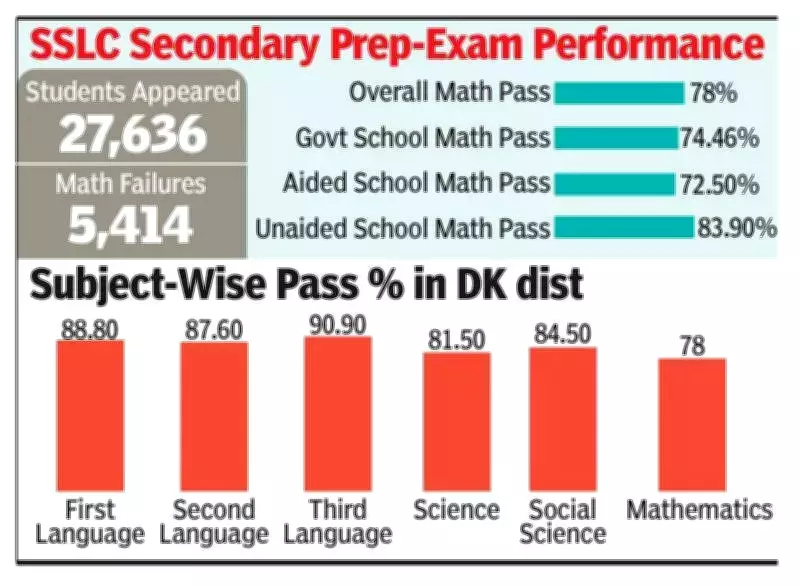
In a significant development for secondary education in Karnataka, government school students in Dakshina Kannada district have reported a 74.4% pass rate in mathematics during the second preparatory SSLC examination held in January. This outcome has prompted the Department of School Education and Literacy to implement a robust series of interventions aimed at enhancing student performance before the crucial board tests.
Department Rolls Out Specialized Support Initiatives
According to DDPI GS Shashidhar, the department has launched special classes and deployed expert teachers to provide targeted support, particularly in schools identified as low-performing. Teachers who have undergone online training will now be strategically assigned to assist students in preparation for the upcoming examinations. This move comes in response to departmental figures revealing that out of 27,636 students, 5,414 failed mathematics, highlighting an urgent need for remedial action.
The overall pass percentage for mathematics stood at 78%, which contrasts sharply with other subjects: first language at 88.8%, second language at 87.6%, third language at 90.9%, science at 81.5%, and social science at 84.5%. Officials have acknowledged this disparity, leading schools to intensify their remedial efforts ahead of the next preparatory exam and the final SSLC board test.
Disparities Across School Categories and Underlying Challenges
Further analysis of the data shows notable differences in performance across school types. Aided schools recorded a 72.5% pass rate in mathematics, while unaided schools achieved 83.9%. Department officials attribute these variations to differing support systems, though they emphasize that mathematics remains a challenging subject across all categories.
Headteachers have pointed to persistent difficulties, especially in government schools, stemming from late academic focus and limited external support. One headteacher explained that mathematics often receives concentrated attention only in the SSLC year, rather than being strengthened in earlier classes such as 8 and 9. While government high schools employ well-trained teachers, outcomes have not met expectations due to these systemic issues.
The teacher added that mastering mathematics requires more than memorization; it demands consistent practice and conceptual understanding. Many government school students cannot afford private tuition, a resource commonly relied upon by their counterparts in aided and unaided schools, exacerbating the performance gap.
Targeted Interventions and Strategic Preparations
In response, schools have begun implementing targeted interventions after reviewing performance data from both preparatory exams. An SSLC coordinator emphasized that repeated practice and revision are essential for success. Schools are now using this data to identify weak areas and students in need of additional support, ensuring a more personalized approach to learning.
Officials have also distributed model question papers and answer keys to aid preparation. Another official noted that small errors in applying formulae can derail entire answers, making the mathematics paper appear deceptively simple yet confusing under exam pressure. To address this, the department has announced that expert teachers will coach students who failed, with low-performing schools receiving focused attention in the lead-up to the next preparatory test.
These comprehensive measures reflect a concerted effort to bridge the performance gap and equip students with the skills needed to excel in mathematics, ultimately aiming for improved results in the upcoming SSLC examinations.