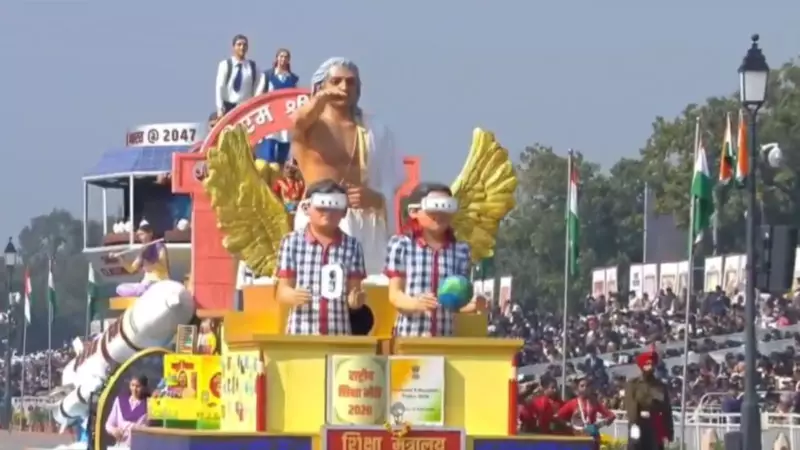
The Republic Day Parade of 2026 witnessed a spectacular showcase of India's educational vision as the Department of School Education and Literacy presented a tableau that masterfully blended the nation's ancient wisdom with contemporary pedagogical advancements. This vibrant display served as a powerful visual narrative of how school education is being transformed into a crucial engine for achieving the ambitious goal of 'Viksit Bharat 2047'.
Bridging Ancient Legacy with Modern Innovation
At the forefront of the float, an idol of the legendary mathematician Aryabhata stood as a sentinel, overseeing cheerful children who held symbolic representations of 'Shunya' (zero) and a globe. This poignant imagery underscored India's profound and enduring contributions to global knowledge systems while emphasizing the sacred responsibility of passing this rich intellectual legacy to future generations.
NEP 2020: The Wings of Transformation
Behind these children, expansive wings served as a central metaphor for the National Education Policy 2020. These wings represented how NEP 2020 is empowering students with enhanced confidence, creating unprecedented opportunities, and fostering global readiness—all firmly rooted in the foundational principle of 'Aatmanirbharta' or self-reliance. The tableau's narrative elegantly spanned from ancient educational traditions to future-ready learning methodologies, all unified under the symbolic arch of a PM SHRI School.

Digital Integration and Foundational Learning
The display featured children actively engaged with Virtual Reality headsets, visually capturing the theme of "ancient roots, digital wings." This demonstrated how modern technology is being seamlessly integrated with traditional knowledge systems. Simultaneously, the 'Jaadui Pitara' section highlighted the policy's emphasis on joyful, play-based foundational learning conducted in mother tongues, utilizing indigenous toys and multilingual educational materials.
Holistic Development and Environmental Consciousness
The tableau prominently featured the gate of a Prime Minister Schools for Rising India (PM SHRI) institution, where children were depicted planting saplings. This scene powerfully symbolized the core values of inclusion, environmental awareness, and the operational ethos of Mission LiFE (Lifestyle for Environment). Another segment showed a student skillfully interacting with various tools, emphasizing the critical importance of introducing skill-based education from the earliest stages of learning.
Blending Tradition with Technological Advancement
The central section of the float presented a holistic integration of martial arts, performing arts, and sports into the educational framework, showcasing the comprehensive development approach advocated by NEP 2020. A robotic hand served as a striking symbol of the seamless convergence between tradition and technology—illustrating the educational journey from the traditional 'takhti' (slate) to modern tablets, all guided by strong ethical values and cultural principles.
Vision for Viksit Bharat 2047
The tableau culminated at an impressive representation of the Viksit Bharat 2047 tower, which displayed advanced smart classrooms, innovative tinkering laboratories, and dynamic innovation hubs. Icons of books, mechanical gears, and electronic circuits collectively represented PM SHRI Schools as living embodiments of the National Education Policy 2020. This vision aims to transform every child—regardless of geographical region, gender, or ability—into a skilled, value-driven citizen prepared for the challenges of the 21st century.
In this grand narrative, NEP 2020 was presented as the powerful rocket accelerating India's comprehensive school education reforms, propelling the nation decisively toward its status as a developed country. The Republic Day parade thus became a platform not just for celebration, but for articulating a clear, ambitious roadmap for India's educational future, connecting glorious historical achievements with transformative contemporary policies.