Bengaluru: Days after the state government rolled out its ambitious plan to convert government schools in 15 districts from the Nali Kali system to mono-grade bilingual classrooms, several government schools across Karnataka are struggling with an embarrassing reality: no benches or desks and, in some cases, not even enough classrooms.
The transition, effective June 1, was meant to move away from the decades-old Nali Kali model, where Classes 1 to 3 learned together in a play-based, activity-oriented environment, often seated on the floor. While the policy changed overnight, the infrastructure did not.
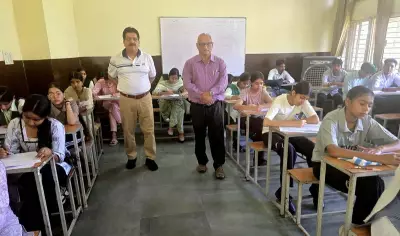
A reality check by TOI across multiple districts found children continuing to sit on floors, crouching over their books as they write. In many classrooms, children are seated around the room, leaning on the walls, with the teacher seated on a chair in the middle. In some schools, small plastic chairs are available, but with no desks, students keep their books on their laps to write.

Headmasters Seek Donations and CSR Funding
Headmasters said they plan to seek donations and CSR funding to purchase basic classroom furniture. "Earlier, the department had sought data on infrastructure availability. We are hoping something comes by. Otherwise, we will have to look for donors. If we have to make it look like proper classrooms, a minimum amount of furniture is required," said a headmistress of a primary school in Bengaluru. Another teacher from Mysuru said CSR funds, supported by local organizations and SDMCs, are not enough to ensure furniture for all. "In many schools, teachers are arranging benches and desks from their salaries," she said.
Shortage of Classrooms and Teachers
Some schools also said they do not have enough classrooms to seat children separately by grade. "We have classrooms, but not enough teachers. There are three teachers and five classes. So Classes 1 and 2 are sitting together," said a teacher from East Bengaluru.
A member of the teachers' association from Mysuru said: "Cancellation of Nali Kali is a good move. But the question is how to hold classes separately for children of Classes 1-3 without sufficient infrastructure. LKG and UKG classes have also been started in many schools without sufficient furniture procurement. Primary school students are given step-motherly treatment."
Some Districts Are Better Off
Deputy Director of Public Instruction (DDPI) GS Shashidhar said schools in Dakshina Kannada generally possess basic infrastructure facilities. Under the Nali Kali programme, primary schools were provided child-friendly furniture, including small chairs, desks and moon-shaped tables, he noted.
There are, however, a few exceptions. For instance, Dakshina Kannada Zilla Panchayat Government Higher Primary School, Mularapatna (Urdu), Rayi in Bantwal, is attending classes seated on carpets due to a shortage of benches and desks. The school urgently requires 17 sets of benches and desks. The school currently has 65 students studying in Classes 1 to 3, including 23 fresh admissions to Class 1 this academic year. "Since it has begun raining and the floors are cold, students are made to sit on carpets. We do not have furniture for Classes 1 to 3," she said.
Bantwal Block Education Officer (BEO) has initiated a drive to identify schools facing furniture shortages and has asked head teachers to submit their requirements. Around 60 primary schools in the block have sought benches and desks, hoping either for government support or sponsorship from donors.
Schools in Dharwad and Hubballi
Schools in Dharwad district also mentioned that sufficient benches and desks are available, many of which are provided by donors. HM Fadneshi, Block Education Officer, Hubballi city, said most schools already had benches and desks, and some had ground tables and small chairs donated by organizations. He said officials instructed schools to organize a transition period for one month, after which classes would begin and children would sit and attend. He said if there was any shortage of benches, it would be brought to the attention of officials.
Officials said a clearer picture of the requirement across the district is likely to emerge once the admission process is completed by the end of this month. Several schools are currently assessing their infrastructure needs based on the final student strength.

"This has exposed the gap between policy announcements and implementation. Many new programmes are planned, but the government is not supporting them with enough resources. Many schools are struggling with minimal furniture. Meanwhile, the department is also pressuring us to increase enrolment," said Moideen Kutty, state coordinator, Karnataka State School Development Monitoring Committee Coordination Centre Forum.
(With additional inputs from Shrinivasa M in Mysuru, Deepthi S in Mangaluru, Akshaykumar in Hubballi and Mrityunjay Yallapurmath in Belagavi)
Official Response
Government schools have enough infrastructure. All it needs is redeployment — moving furniture from schools that do not need them to others. Additionally, procurement and delivery of new furniture is underway. Schools need not look for private funding. This is just the beginning of the academic year. Initial hiccups will be sorted out soon, said Rashmi V Mahesh, additional chief secretary, department of school education and literacy.