The Karnataka government has issued a sweeping directive to all schools, colleges, universities, and coaching centres across the state, compelling them to adopt and implement the Supreme Court's uniform guidelines for mental health on campus. The circular mandates compliance within the next six months or by the commencement of the next academic year, whichever is earlier.
Core Directives of the Supreme Court Guidelines
The action follows a landmark order by the Supreme Court in July, which established a 15-point framework for educational institutions nationwide in response to a troubling series of student suicides. The state's circular enforces these guidelines in their entirety.
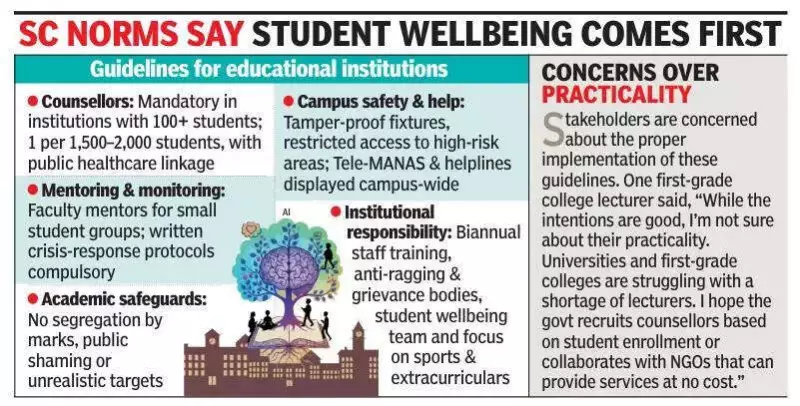
Key mandates include the appointment of qualified mental health professionals. Every institution with an enrollment of 100 or more students must have at least one trained counsellor, psychologist, or social worker specializing in child and adolescent mental health. A ratio of one counsellor for every 1,500 to 2,000 students must be maintained, and formal ties with public healthcare facilities are required.

The guidelines call for a fundamental shift in institutional culture. They explicitly recommend against segregating students based on academic performance, public shaming, and setting unrealistic academic targets—common practices in exam-focused coaching centres. Instead, faculty mentors should be assigned to small student groups to offer consistent, informal support, especially during exams and critical academic transitions.
Infrastructure, Protocol, and Training Overhaul
On the infrastructure front, the government has ordered tangible safety measures. Residential and non-residential campuses must install tamper-proof ceiling fans and other safety devices. Access to high-risk areas like rooftops and balconies, as well as to unsafe materials, must be restricted to prevent impulsive acts.
Institutions are also required to develop clear, written protocols for managing students in severe distress or suicidal crisis. Prominent display of national helpline numbers, including Tele-MANAS, in hostels, classrooms, and common areas is compulsory.
A significant focus is on training and committee formation. All teaching and non-teaching staff must undergo mandatory orientation sessions twice a year, led by certified mental health professionals. These will cover psychological first aid, identifying warning signs, and managing suicide risk.
Furthermore, every institution must establish an anti-ragging cell, an internal complaints committee for sexual harassment, a student grievance redressal committee, and a dedicated Student Wellbeing Team (SWT). The SWT, comprising counsellors, trained faculty, students, and parents, will drive mental health awareness initiatives. The guidelines also stress the importance of physical activity, directing schools to use scheduled physical education periods exclusively for sports and fitness.
Stakeholders Raise Practical Concerns
While the move has been welcomed for its intent, stakeholders on the ground have expressed concerns about practical implementation. A first-grade college lecturer highlighted existing challenges, stating, "While the intentions are good, I'm not sure about their practicality. Universities and first-grade colleges are struggling with a shortage of lecturers. I hope the government recruits counsellors based on student enrollment or collaborates with NGOs that can provide services at no cost."
The state government's circular now places the onus on thousands of educational institutions in Karnataka to translate these comprehensive guidelines into actionable and sustainable on-ground support systems for student mental health within a strict timeline.