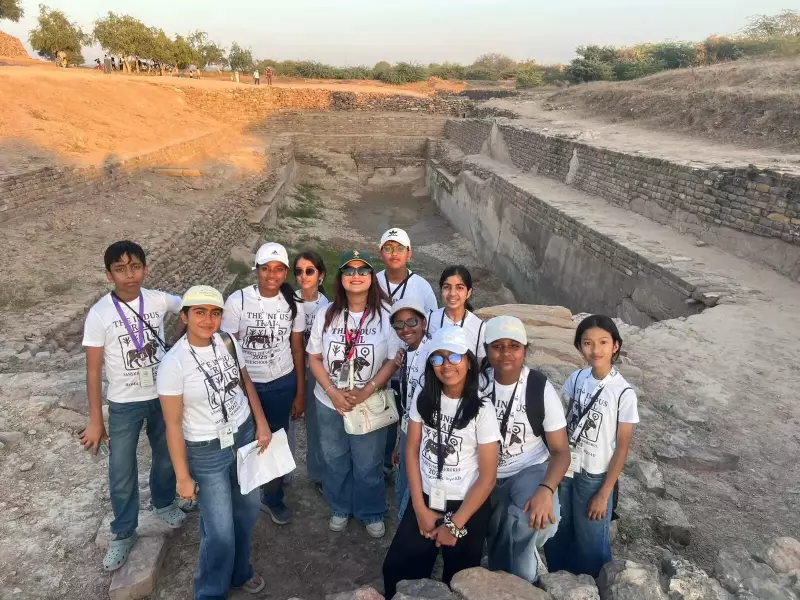
Guwahati's premier educational institution, Sanskriti The Gurukul, has achieved a significant milestone in innovative pedagogy by successfully completing the Indus trail. This immersive educational excursion took students on a transformative journey to the archaeological sites of the ancient Indus Valley Civilisation, bridging the gap between textbook knowledge and real-world historical engagement.
A Pioneering Approach to Historical Education
School officials have described this meticulously planned journey as a groundbreaking achievement in experiential learning methodologies. The program was specifically designed to provide students with opportunities to transcend conventional classroom boundaries and directly interact with the enduring legacy of one of humanity's earliest urban civilizations.
Transforming History into Living Experience
Prapti Borah, coordinator of middle school history and civics at Sanskriti The Gurukul, emphasized the profound impact of this educational approach. "Through direct interaction with archaeological sites, cultural spaces, and lived traditions, history transformed into a powerful, memorable experience rooted in inquiry and exploration," she explained. This pedagogical strategy represents a deliberate shift from passive learning to active historical engagement.

Comprehensive Exploration of Indus Valley Sites
The Indus trail encompassed visits to multiple historically and culturally significant locations that offered students unparalleled insights into ancient civilization:
- Lothal: One of the most prominent cities of the ancient Indus Valley, renowned for its sophisticated dockyard and urban planning
- Bhuj-Kutch Museum: Housing extensive collections of artifacts that illuminate the region's rich cultural heritage
- Dholavira: A remarkable archaeological site showcasing advanced water conservation systems and urban architecture
- Surkotada: Providing evidence of early settlement patterns and material culture
Enriching Hands-On Learning Experiences
Beyond site visits, the educational program incorporated interactive workshops and cultural immersion activities. Students participated in traditional pottery workshops, gaining practical understanding of ancient craft techniques. The journey also included participation in the vibrant Rann Utsav, allowing students to experience contemporary cultural expressions rooted in historical traditions.
Redefining Educational Paradigms
This innovative approach to history education demonstrates how carefully designed experiential learning programs can create lasting educational impact. By physically engaging with archaeological evidence and cultural practices, students developed deeper connections with historical narratives that often remain abstract in conventional classroom settings.
The success of the Indus trail establishes a new benchmark for educational excursions, proving that immersive historical experiences can significantly enhance student understanding, critical thinking skills, and cultural appreciation. Sanskriti The Gurukul's initiative serves as an inspiring model for educational institutions seeking to implement more engaging and effective approaches to teaching ancient civilizations and cultural heritage.