Delhi's Evening School Boys Struggle as Double-Shift System Creates Learning Gap
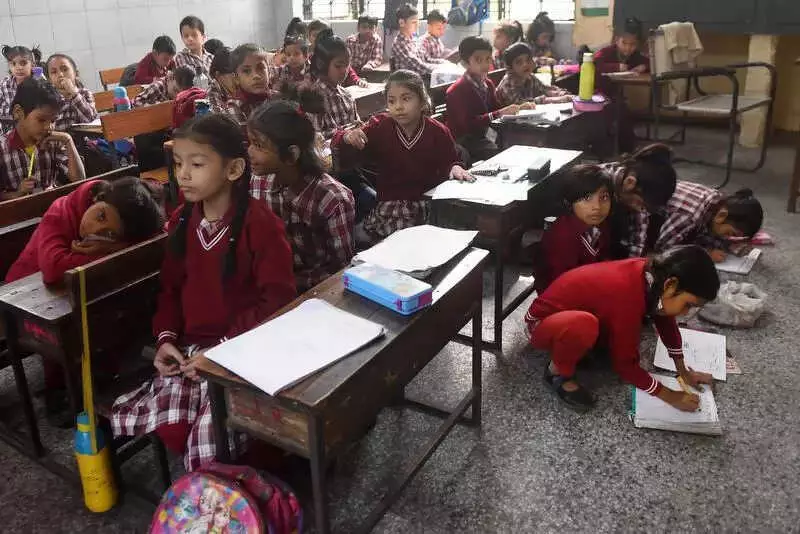
At 3:30 PM, when most classrooms stand empty, the school day begins for thousands of boys across New Delhi. Many arrive already tired. They have spent their mornings helping in family shops, running errands, or traveling long distances. By the time lessons start, their energy levels are low. This daily reality has shaped learning outcomes for years in hundreds of double-shift schools.
A System Born from Scarcity
Delhi's double-shift schooling system emerged as a response to land scarcity and overcrowded classrooms. With limited infrastructure and rising enrollment, many schools started two shifts. What began as a logistical solution has now evolved into a parallel system with uneven conditions. The morning shift is typically for girls and co-educational classes. The evening shift is reserved for boys who need to help their families earn money during the day.
The Directorate of Education currently operates 799 school buildings. Of these, 284 run in two shifts. These double-shift campuses often stretch infrastructure and staff capacity to their limits. Morning-shift schools operate from 7:30 AM to 1:30 PM. Evening-shift schools function from 3:30 PM to 6:30 PM.

The Performance Disparity
Government data now makes visible what teachers and parents have long felt. Students in morning-shift classes perform better. They show stronger overall learning outcomes. Stable routines and full-day access to school infrastructure help their learning. Students who begin their day fresh rather than fatigued appear to learn better.
In contrast, boys-only evening schools struggle. They face compressed schedules of just three hours. They experience weaker academic continuity and limited engagement. These factors create systemic disadvantages that extend beyond individual effort.
Pass percentages often appear similar at first glance. However, the scoring average, which gives the qualitative index, reveals the true disparity. Data across five years from 2019 to 2024 shows a consistent lag in the performance of boys' schools with evening classes.
In Class X for the 2023–24 academic year, boys' schools recorded a pass percentage of 93.82%. This was almost identical to girls' schools at 93.83%. But their Qualitative Index was significantly lower—269.29 versus 281.9. This pattern bore out in the Class XII results too. Boys' schools posted a 95.96% pass rate compared to girls' 97.35%. Their QI was much lower at 299.67 against 316.23.
The Evening Shift Challenge
An even sharper gap is visible between morning and evening shifts directly. In Class X, evening-shift schools had a pass percentage of 92.84%. This was nearly 2 percentage points lower than morning schools at 94.76%. Their QI was substantially lower at 266.85 versus 282.3.
The same trend holds in Class XII. Evening shifts recorded the lowest pass rate at 95.33% and a QI of 296.2. The general pass rate was 98.19% with a QI of 320.63. Morning shifts had a pass rate of 96.96% and a QI of 312.63. Since 2020, evening-shift schools have consistently shown the weakest outcomes.
Roots of the Problem
Educationists say these outcomes are closely tied to students' lived realities. Many boys in evening schools spend the day working. With limited academic supervision at home, schoolwork competes with economic pressure. Parents often lack formal education. Irregular attendance and weak monitoring further erode learning continuity.
"The evening shift has always received stepmotherly treatment," said former Delhi University professor Rama Mathew. "While sharing resources through double shifts may seem practical on the surface, serious operational problems persist."
Education activist and lawyer Ashok Agarwal echoed this concern. "The evening shift has a very poor track record. Both teachers and students tend to treat it as secondary. Schedules are loosely followed, and serious teaching often suffers," he said.
Government Plans and Hurdles
The government is now planning to convert double-shift schools to single-shift in a phased manner. Efforts to undo this arrangement are not new. In 2019, a proposal to convert 92 double-shift schools into single-shift ones was approved. The pandemic halted its implementation.

Experts caution that dismantling the double-shift system will not be easy. A senior professor familiar with Delhi's school education system highlighted the challenges. "Children are more attentive in the morning. Routines are stable, and learning is more structured. Double shifts exist only because there are not enough classrooms," he said. "Classrooms often accommodate more than 60 students, especially in higher grades. Without additional space and teachers, a single-shift model cannot function effectively."
Land availability remains a critical bottleneck. With agencies like the DDA controlling land and education falling under the Delhi government, coordination delays expansion. A Delhi government official stated that the Directorate of Education has proposed new schools on available land. "Plans include constructing 10 schools annually, with a target of 50 by 2029," he said.
Professor Mathew summarized the dilemma. "At the same time, infrastructure cannot be created overnight. A shift cannot simply be removed without first ensuring that students have an alternative school to attend," she said.
The data tells a clear story. While the double-shift system solved an immediate space crisis, it created a lasting learning gap. The boys attending evening schools pay the price with weaker academic achievement. The path to a single-shift system requires careful planning, significant investment, and time.