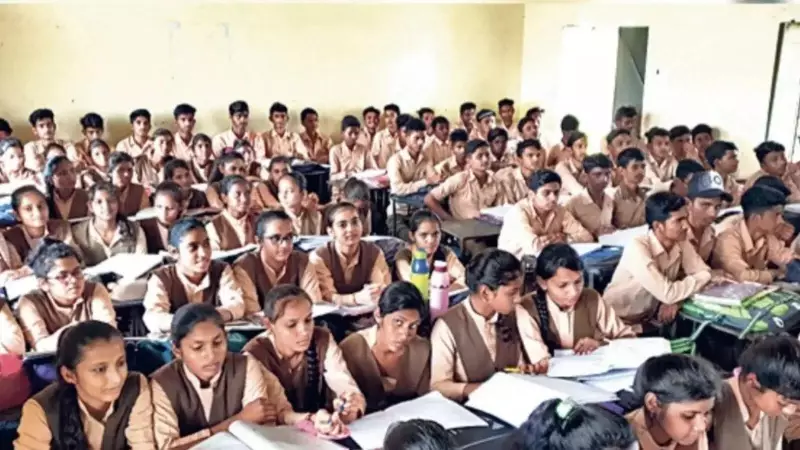
In a development raising serious concerns over educational access in tribal regions, a total of 686 government and government-aided schools have been shut down or merged across four districts in Odisha's undivided Koraput region over the last five years. This information was provided by Minister of State for Education Jayant Chaudhary in a written reply to the Lok Sabha on Monday.
MP Raises Alarm Over Tribal Student Deprivation
The data was revealed in response to an unstarred question posed by Koraput Member of Parliament Saptagiri Sankar Ulaka. Raising the issue in Parliament, Ulaka described the widespread closure of schools as a matter of deep concern, disproportionately affecting children from remote tribal communities. He argued that the trend contradicts the goal of improving learning outcomes.
"Mass closure of schools in one of India's most educationally backward and tribal-dominated regions is unacceptable," Ulaka stated. "This is not rationalisation; this is deprivation. You cannot improve learning by shutting down schools in remote Adivasi areas. Our children deserve more schools, more teachers and more investment, not fewer opportunities."

Severe Impact on Access and RTE Norms
According to the ministry's reply, the closure or merger of schools, which were mostly satellite institutions, has directly impacted 8,854 students. A significant proportion of these students belong to Scheduled Caste and Scheduled Tribe communities, including a large number of girls.
Ulaka highlighted that with neighbourhood schools shutting down, children are now forced to travel much longer distances across difficult, hilly, and forested terrain to reach the nearest institution. This, he alleged, is a clear violation of the Right to Education (RTE) Act norms, which mandate specific distance limits for schools.
The RTE Act requires a school within 1 km for primary classes (I-V), 3 km for upper primary (VI-VIII), and 5 km for secondary levels. Ulaka pointed out that children in remote tribal belts are now walking far beyond these legally mandated limits, constituting a serious infringement of their fundamental right to education.
Areas with Maximum Closures and Call to Action
The blocks reporting the highest number of school shutdowns are those with high tribal populations, which already suffer from severe infrastructure deficits. These include Dasmantpur (46 schools closed), Lamtaput (35), Kalimela (27), Nandapur (22), Jharigaon (20), and Muniguda (13).
The ministry also informed Parliament that government and government-aided schools in the four districts—Koraput, Rayagada, Malkangiri, and Nabarangpur—currently serve 8.88 lakh students, indicating immense pressure on already stretched resources.
Urging both the Odisha state government and the Union Ministry of Education to intervene urgently, MP Ulaka put forward several demands:
- An immediate review and reversal of school closures in tribal and hilly areas.
- Strict enforcement of RTE distance norms to ensure access.
- Filling all vacant teacher positions in the region.
- A comprehensive plan to strengthen school infrastructure.
- Priority for tribal education, including expansion of Eklavya Model Residential Schools (EMRS) and other accessibility initiatives.
The large-scale consolidation of schools in this sensitive region underscores the ongoing challenge of balancing administrative efficiency with the imperative of providing equitable and accessible education to India's most vulnerable communities.