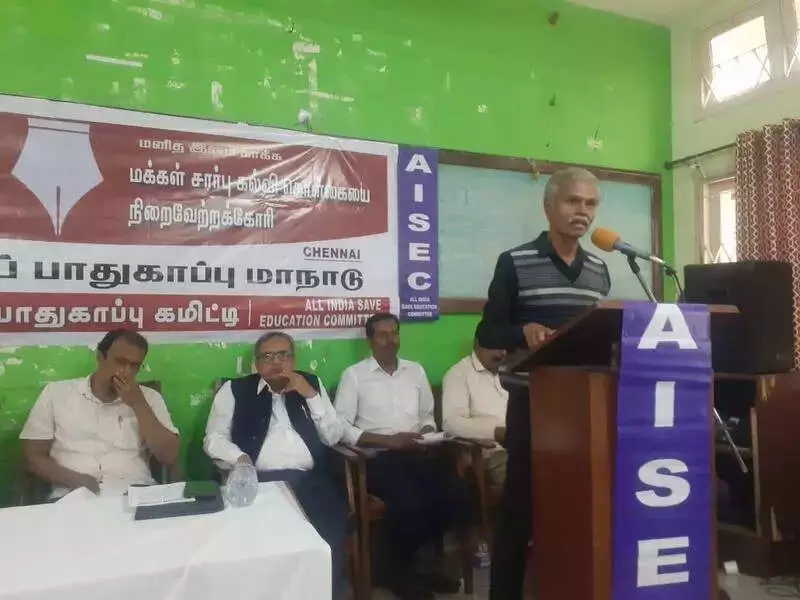
Educationists and academics have raised a red flag against the proposed Vikshit Bharat Shiksha Bill 2025, warning that it will lead to excessive centralization of India's higher education system and severely impact the autonomy of states and their universities. The concerns were voiced prominently at a conference held in Chennai on Saturday.
Conference Sounds Alarm on New Education Bill
The conference, organized by the All India Save Education Committee (AISEC), was convened with the aim of safeguarding the public education system. Participants, comprising veteran educationists, passed several critical resolutions. The most significant among them was a call for the complete withdrawal of the National Education Policy (NEP) 2020 and the State Education Policy (SEP) 2025.
The core of their apprehension lies in the Vikshit Bharat Shiksha Aadhishthan Bill, which has been introduced in Parliament. This legislation seeks to establish a single, overarching regulatory authority for higher education, effectively replacing existing bodies like the University Grants Commission (UGC), the All India Council for Technical Education (AICTE), and the National Council for Teacher Education (NCTE). The bill has been referred to a joint committee of Parliament for further scrutiny.

Experts Decry Erosion of State Power
Leading the charge, L. Jawahar Nesan, former Vice-Chancellor of JSS Science and Technology University in Mysuru and a former member of a high-level committee to draft a state education policy, issued a strong critique. He pointed out that the proposed council under the new bill lacks any representation for the states.
"The proposed bill does not have any representation for the states in the council. Further, it would centralize higher education and affect the autonomy of states," Nesan stated. He urged Tamil Nadu Chief Minister M.K. Stalin to oppose the bill and initiate legal proceedings to prevent its enactment.
Nesan further challenged the constitutional premise of the bill, arguing that the Union government does not have the powers to regulate higher education. "It has power only to determine the standards and coordinate," he emphasized, highlighting a potential federal overreach.
Call for an Alternative and Key Demands
Tarun Kanti Naskar, General Secretary of AISEC, labeled the NEP 2020 as a "document of privatization, commercialization, and centralization of education." He stressed the urgent need to save government-funded education in the country. In a significant announcement, Naskar revealed that AISEC will release its final People's Education Policy, envisioned as an alternative to the NEP, on January 24 in Bengaluru.
The conference culminated in a series of resolutions that outline a different vision for Indian education:
- Demand for free education from age three to 17.
- Removal of the NEET and CUET national entrance tests.
- Adoption of a two-language policy in education.
- Moving education back to the State List of the Constitution.
- Increasing budget allocation for education to 10% by the Union government and 25% by state governments.
- Allocating 3% of GDP exclusively for research.
The strong opposition from the academic community sets the stage for a heated debate as the Vikshit Bharat Shiksha Bill 2025 moves through the parliamentary process, touching upon fundamental questions of federalism and the future structure of India's education landscape.