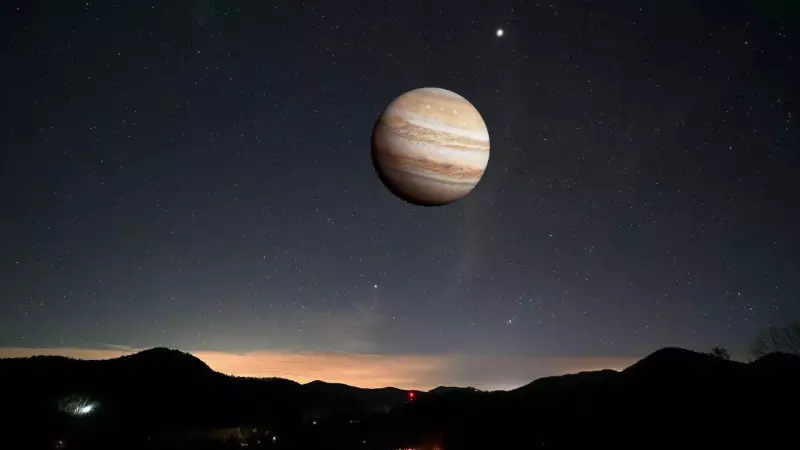
Some evenings, the universe offers a free show. You step outside, perhaps seeking a quiet moment, and find an unexpectedly brilliant light waiting for you. This January, that celestial beacon is Jupiter, the solar system's giant. Unlike twinkling stars or fast-moving satellites, Jupiter will appear as a steady, pale jewel in the night sky, often keeping company with the Moon, prompting spontaneous wonder.
Why Jupiter Will Dominate the January 2026 Sky
The reason for this prominent display is a specific celestial alignment called opposition. On January 10, 2026, at 9 UTC (2:30 PM IST), Earth will pass directly between Jupiter and the Sun. This geometry means Jupiter rises in the east as the Sun sets in the west, remaining visible throughout the night. During opposition, Jupiter reflects maximum sunlight towards Earth and appears slightly larger in our sky.
You won't need to mark that exact afternoon minute, however. The planet's peak brilliance builds over several nights around this date. Interestingly, Jupiter will be closest to Earth a day earlier, on January 9, 2026, at a distance of roughly 633 million kilometres. This proximity amplifies its visibility.

How and When to Spot Jupiter from India
The best viewing window stretches across early to mid-January, not confined to a single night. For observers across India, the plan is simple:
- When: Late evening, after the sky has fully darkened. Jupiter will be well-placed in the sky soon after sunset.
- Where to Look: Face east. Jupiter will be situated in the constellation Gemini. You don't need to find Gemini; just look for the brightest, non-twinkling "star" in that part of the sky. With Venus hidden behind the Sun, Jupiter will have no rival in brightness.
- What to Use: Your naked eye is perfectly sufficient. Jupiter will look like a sharp, bright point of steady light. If it's near the Moon, Jupiter will be the brighter of the two.
Enhancing Your View: From Dots to Moons
While stunning to the unaided eye, simple binoculars can transform the experience. Even a basic pair will resolve Jupiter's pinprick of light into a tiny, distinct disk. More excitingly, you will likely see some of its four largest moons—Io, Europa, Ganymede, and Callisto—appearing as faint, aligned beads of light beside the planet.
A telescope can reveal the planet's cloud bands, but binoculars often provide the perfect, personal connection to this distant world.
This opposition event does not occur every calendar year. Jupiter takes about 12 years to orbit the Sun, and Earth's faster orbit brings us into opposition with Jupiter approximately every 13 months. This is why 2025 will have no Jupiter opposition. After January 2026, the next chance will be on February 10, 2027, with the planet shifting its backdrop to a new zodiac constellation.
So, this January, grant yourself a moment under the stars. Look east, and meet the king of the planets at its brilliant best.