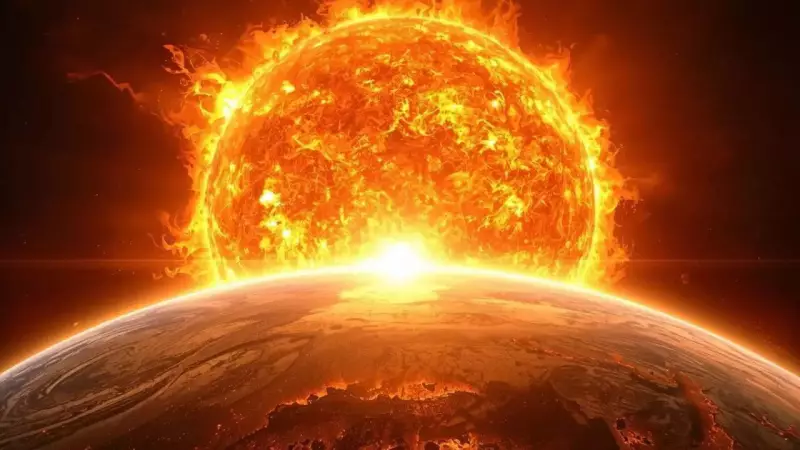
All things that begin must eventually end. This universal truth applies to everything from living organisms to celestial bodies, including our own vibrant planet, Earth. Scientists have now pieced together a chilling prediction for our solar system's ultimate demise, revealing a fate that awaits us billions of years from now.
The Inevitable Stellar Expansion
Our sun is currently at the midpoint of its lifespan, which means Earth is on a similar timeline. While the catastrophic event is estimated to be at least 5 billion years away, researchers have used new data to forecast how it will unfold. The process begins when a star like our sun exhausts its core hydrogen fuel.
At this critical juncture, the star undergoes a dramatic transformation, expanding its diameter by more than a hundredfold. This massive expansion allows the star to engulf any planets orbiting too closely. A study led by astronomers Edward Bryant of the University of Warwick and Vincent Van Eylen of University College London provides compelling evidence for this theory.

How Giant Stars Destroy Their Planetary Systems
The research team analyzed data from NASA's TESS (Transiting Exoplanet Survey Satellite) observatory. They compared planetary systems around stars in their main sequence—like our current sun—with those around older, post-main sequence stars nearing the end of their lives.
"We saw that these planets are getting rarer [as stars age]," Edward Bryant told Space.com. The scarcity of planets around aging stars points towards destruction, not a formation issue. Bryant clarified, "We're fairly confident that it's not due to a formation effect... we don't see large differences in the mass and [chemical composition] of these stars."
The destruction mechanisms are multifaceted. While complete engulfment is one fate, growing stars also exert immense tidal forces on nearby planets. These forces can decay planetary orbits, strip away atmospheres, and ultimately tear worlds apart.
TESS Data Reveals a Statistical Truth
Bryant and Van Eylen sifted through TESS data containing 456,941 post-main-sequence stars. Within this vast sample, they identified 130 planets and planet candidates with close-in orbits. The key finding was a significant drop in the fraction of stars hosting planets, especially those with short orbital periods.
This decline strongly aligns with theoretical predictions of intense tidal decay as stars evolve. TESS discovers exoplanets by detecting the slight dimming—or "transit"—that occurs when a planet passes in front of its host star. This method is most effective for finding large planets in tight orbits.
While the studied systems differ from ours in scale, the stars have masses comparable to our sun. A star with the sun's mass will follow an identical life cycle, offering a direct window into our solar system's future. Astronomer Sabine Reffert of Universität Heidelberg, who was not part of the study, highlighted the breakthrough: "We had never seen this kind of difference in planet occurrence rates... before because we did not have enough planets to statistically see this difference."
Refining the Predictions
Exoplanet science, though highly successful, faces complexities. Older stars typically have lower metallicity—a measure of elements heavier than helium. Since high metallicity often correlates with abundant planets, this factor needs careful consideration.
"A small difference in metallicity…could potentially double the occurrence rate," noted Reffert. She affirmed the study's general conclusions are robust, but future research with better metallicity data will refine the details.
The study, published in the journal Nature, offers humanity a profound and humbling preview. Although Earth's fiery end lies in the unimaginably distant future, scientists now have a substantial body of evidence showing how dying stars ultimately consume their planetary children.