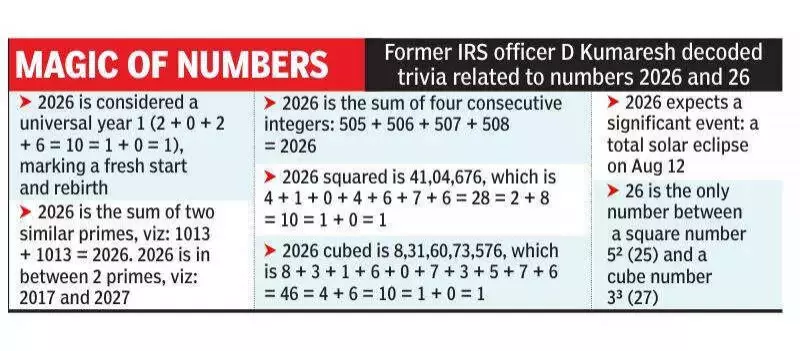
A retired professor from Bengaluru has unveiled a series of intriguing mathematical characteristics associated with the upcoming year 2026, blending number theory with historical and philosophical context. The analysis by city-based KV Narayana, who holds a PhD in number theory, reveals that 2026 is far more than just another year on the calendar.
A Calendar with Familiar Echoes
Narayana points out that the year 2026 will be a non-leap year with 365 days. It holds a unique symmetry, as it will both begin and end on a Thursday. This specific alignment means the calendar for 2026 is identical to those used in the years 2015 and 2037. For anyone saving an old calendar, it might just be time to retrieve the one from a decade prior.
The Perfection of Number Six and Prime Intricacies
Delving deeper, the professor highlights the significance of the last digit of 2026, which is 6. In mathematics, 6 is known as a perfect number. A perfect number is defined as a positive integer that is equal to the sum of its proper positive divisors. For 6, these divisors are 1, 2, and 3, and indeed, 1 + 2 + 3 = 6.

Narayana connects this to the philosophical realm by quoting the Greek philosopher Saint Augustine, who noted that God took six days to create the world. Thus, the number 6 symbolises perfection and completeness in both a mathematical and a Biblical context, suggesting a divine harmony in creation.
The numerical dissection of 2026 yields further surprises. The year's number itself is a product of two prime numbers: 2 and 1013 (2 x 1013 = 2026). Intriguingly, it is also the sum of two other prime numbers: 23 and 2003 (23 + 2003 = 2026).
Sequential Patterns and Digit Mysteries
Another fascinating property lies within a specific arithmetic sequence. Consider the progression: 1, 10, 19, 28, ………. 2026. This is an Arithmetic Progression (AP) with a first term of 1 and a common difference of 9. Narayana calculates that within this sequence, 2026 is the 226th term.
The connection deepens when examining the digits. The term number, 226, shares the exact same non-zero digit pattern (2, 2, 6) as the year 2026 (2, 0, 2, 6). This creates a strong and elegant property linking the position of the year in the sequence to its own numerical identity.
The work of Professor Narayana transforms the simple act of flipping a calendar page into an appreciation of the hidden numerical elegance that structures our perception of time. It reminds us that years are not just measures of duration but can be vessels of mathematical beauty and historical resonance.