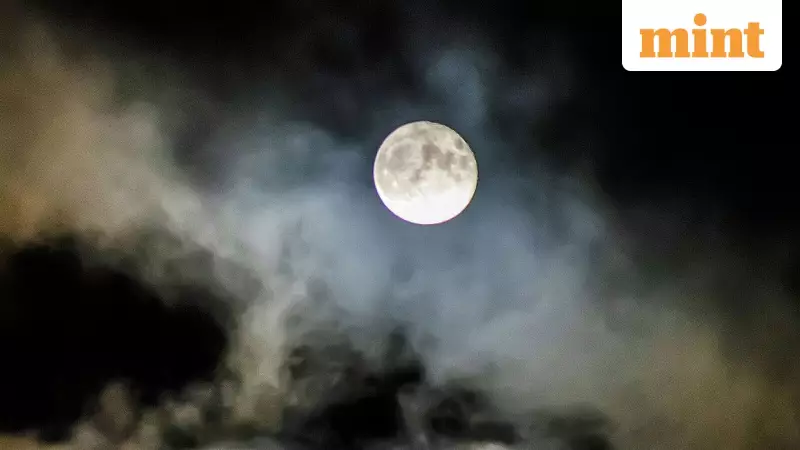
Indian sky enthusiasts have a celestial treat in store today as the first full moon of 2026, a spectacular supermoon known as the Wolf Moon, is set to illuminate the night sky. This lunar event marks not just the beginning of the year's lunar calendar but also the conclusion of a series of supermoons.
When and How to Witness the Wolf Moon
According to Time and Date, the peak of the Wolf Moon will occur today, Saturday, January 3, 2026. For observers in India, the moon will rise around 3:32 PM Indian Standard Time (IST). The best viewing will be after sunset when the moon is higher in the sky. The good news for everyone is that no special equipment is needed; this bright supermoon can be fully enjoyed with the naked eye. Photography enthusiasts are encouraged to grab their cameras to capture the brilliant sight of the year's inaugural full moon.
The Significance and Many Names of January's Moon
This full moon carries rich cultural and traditional significance across different parts of the world. Its most common name, the Wolf Moon, originates from the ancient practice of naming moons after seasonal events. It is named for the howling of wolves heard during the deep winter in the Northern Hemisphere.

Other cultures have their own names for this lunar event. In Anglo-Saxon tradition, it is called the "Moon After Yule." For the indigenous Dakota people of North America, it is known as the "Severe Moon," a name recorded by the Old Farmer's Almanac that reflects the harsh, bitter cold typical of this month. In the Alaska Range, it is referred to simply as the "Winter Moon."
Why Is It a "Supermoon"?
A full moon is a regular celestial event that happens approximately every 27 days when the moon is positioned directly opposite the sun in Earth's sky, making its entire face visible from our planet. However, today's moon is special because it is also a supermoon.
This occurs when a full moon coincides with perigee—the point in the moon's orbit where it is closest to Earth. This proximity makes the lunar disk appear significantly larger and brighter in our sky. In fact, compared to the most distant full moon of the year (apogee), a supermoon can appear up to 14% larger and 30% brighter. While the moon may look full on surrounding nights, its peak illumination as a supermoon is today.
This January supermoon is notably the last in a string of four consecutive supermoons. As reported by Space.com, after tonight, cosmic enthusiasts will have a long wait until the next supermoon, which is scheduled for November 24, 2026. The next full moon of the year, which will not be a supermoon, will be visible on February 1, 2026.